
Reliable Emergency Storm Response
in Converse, SC
Professional emergency storm response for Converse homes and properties. 24/7 emergency response and careful property protection.
After a hurricane, tropical storm, or severe thunderstorm in South Carolina, downed trees and broken limbs create immediate danger to homes, vehicles, and families. South Carolina Tree Removal Experts offers 24/7 emergency storm tree response — rapid on-site assessment, controlled hazard removal, and full debris clearing across all of South Carolina. Call (888) 643-4199 for same-day storm response.
South Carolina Storms Hit Hard — and Trees Hit Back
There is a reason South Carolina homeowners watch the weather forecast more carefully than most — this state sits in the path of some of the most destructive storm systems in the entire country. When those systems arrive, the trees on your property are almost always the first thing to give way.
Hurricane season runs officially from June through November, putting the entire South Carolina coast — from Hilton Head straight up to Myrtle Beach — under six months of elevated storm risk every single year. But named hurricanes are only part of the story — tropical depressions, fast-moving squall lines, and isolated severe thunderstorm cells cause serious tree damage across the state in months that fall well outside the official hurricane window.
Summer thunderstorms in the Midlands are a threat of their own kind entirely. A storm cell can build over Columbia or Lexington in under an hour, drop three inches of rain, and leave a saturated Loblolly Pine sideways across a driveway before the thunder has finished rolling.
Upstate South Carolina faces a threat that coastal residents rarely deal with — ice storms. A significant overnight ice accumulation adds hundreds of pounds of weight to every branch in the affected area, and limbs that have held through decades of wind events simply cannot carry that load.
South Carolina’s residential neighbourhoods make the risk even greater. Mature Loblolly Pines tower over rooftops across the Midlands, ancient Southern Live Oaks spread enormous limb structures over Lowcountry homes, and Sweetgums and Tulip Poplars line suburban streets from Columbia to Greenville. These are beautiful trees — until a storm puts them under stress, they were never designed to survive.
When the wind passes, and the damage is sitting in your yard or on your roof, the question is not whether you need help. The question is who you call and how fast they can get there.
What Storm-Damaged Trees Do to South Carolina Properties When You Wait
A storm-damaged tree is not a problem that holds still while you figure out the next steps. Every hour it stays in place, the risk to your property, your family, and your finances grows.
Here is what that delay actually costs South Carolina homeowners:
Partially fallen trees are the most dangerous trees on your property. A tree that came down halfway — leaning against your home, hung up in another tree, or resting across a fence — is under enormous and unpredictable tension. It can shift, drop, or split without any warning, and anyone nearby when it moves is in serious danger.
Storm-weakened trees continue to fail after the storm passes. When a storm damages one part of a tree, the structural stress on surrounding limbs increases dramatically. Branches that look intact may have cracked silently at the attachment point and can fall hours — or even days — after the initial event.
A breached roof becomes a water damage emergency within hours. South Carolina’s humidity means moisture intrusion moves fast — what starts as a punctured roof deck can become saturated insulation, warped framing, and mold growth within 24 to 48 hours. Every hour the tree stays in place is another hour water is finding its way deeper into your home’s structure.
Blocked access creates dangerous secondary consequences. A tree across your driveway is not just an inconvenience — it prevents emergency vehicles from reaching your home if a secondary situation develops. It also traps vehicles you may urgently need.
According to the SC Emergency Management Division, homeowners should begin mitigating storm damage as quickly as possible following any weather event. Insurers expect reasonable steps to prevent further damage — and a delayed response can directly complicate your claim.
Unlicensed operators appear immediately after every major SC storm. After a significant storm event, uninsured crews flood South Carolina neighborhoods, offering fast, cheap removal with no credentials and no accountability. If something goes wrong during an uninsured removal — and in emergency situations, the margin for error is razor thin — the financial and legal consequences land entirely on you.
The USDA Forest Service identifies storm-damaged trees as among the leading causes of post-storm property damage and personal injury in residential areas. In South Carolina, where tree canopy is dense and storm seasons are long, that risk plays out in neighbourhoods across the state every single year.
Waiting is never a neutral decision after a storm. It is a choice that carries compounding consequences — to your home, your safety, and your recovery.
South Carolina’s 24/7 Emergency Storm Tree Response Team
When the storm clears and the damage is visible, South Carolina Tree Removal Experts is ready to move. We do not wait for Monday morning, and we do not ask you to leave a message — when you call (888) 643-4199, a real person answers and dispatch begins immediately.
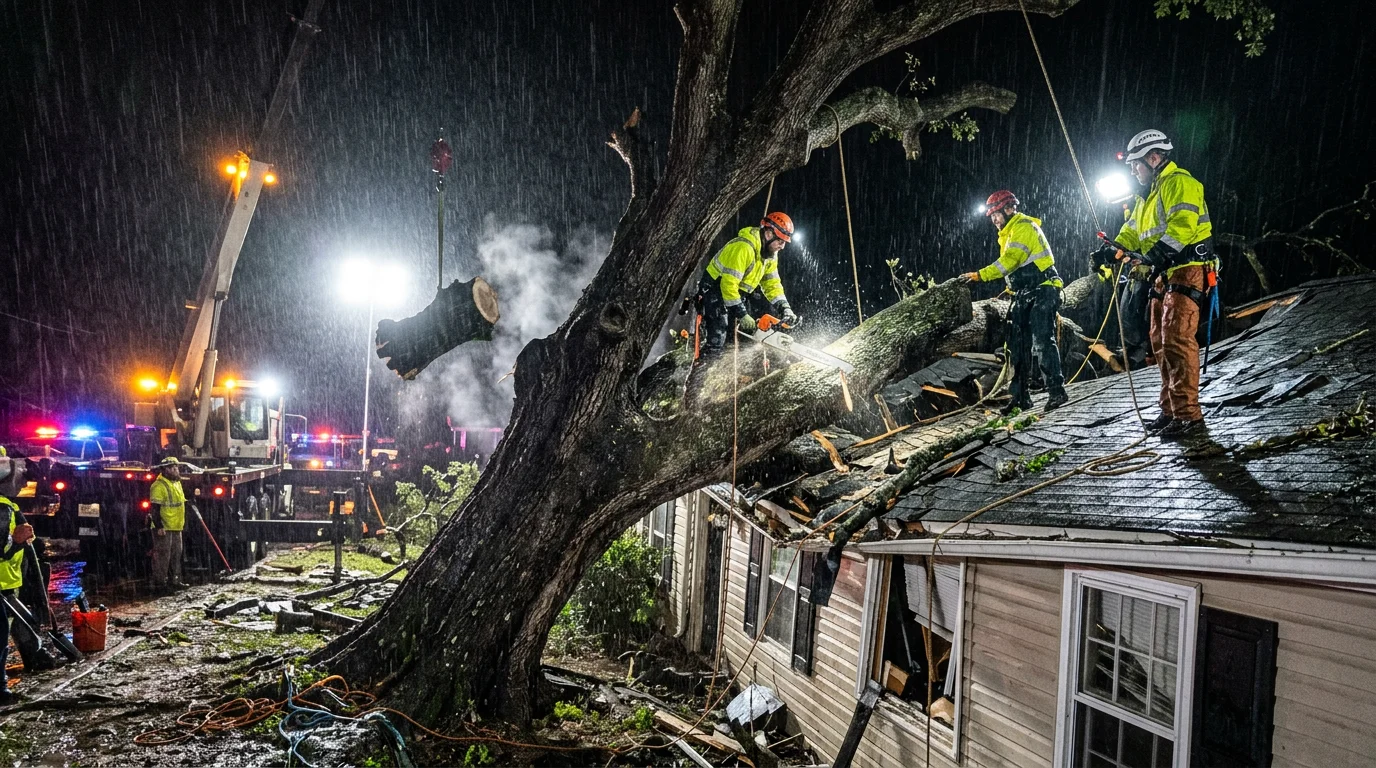
Our crews arrive fully equipped for every storm scenario — chainsaws, rigging equipment, and crane-assisted removal capability for situations where a tree’s position makes standard ground-based cutting too risky. We assess before we cut, we work in controlled sections, and we do not leave until your property is clear.
What We Do When We Arrive at a Storm-Damaged Property
Every storm response begins the same way — with a thorough scene assessment before any equipment touches a single tree. Our crew identifies power line contact, checks for hanging limbs, evaluates root stability, and determines the safest and most efficient removal sequence for your specific situation.
Only once the scene is fully understood do we begin work — and we begin with the most dangerous hazard first. Life-safety threats always come before convenience or speed.
Our Storm Response Process — Step by Step
Step 1 — You Call, We Answer Dial (888) 643-4199 any time, day, night, or in the hours immediately following a storm. We answer, gather your details, and dispatch without delay.
Step 2 — Scene Assessment: Our crew arrives and evaluates every hazard on the property — power line contact, structural loads on buildings, hanging limbs, root uplift, and overall site safety — before work begins.
Step 3 — Priority Hazard Removal We address the most dangerous and structurally urgent hazards first — trees on structures, blocking access routes, or threatening further immediate collapse.
Step 4 — Controlled Tree Removal Working top-down and section by section, we remove storm-damaged trees using the appropriate equipment for each situation. Cranes are deployed when ground-based removal is unsafe or impractical.
Step 5 — Full Debris Clearing Every limb, every branch, every piece of storm debris comes off your property. We haul everything away — your yard will be clear when we leave.
Step 6 — Damage Documentation We photograph and document the removal process from start to finish, giving you everything you need to support your insurance claim.
Equipped for Every Storm South Carolina Delivers
Not every storm poses the same removal challenges, and not every crew is equipped to handle them all. A Loblolly Pine that came straight down in an open yard is a very different job from a Live Oak limb resting across a Lowcountry roofline — and our equipment and approach reflect that difference.
For straightforward fallen tree removal after a storm, our ground crews work fast and efficiently to clear your property. For complex situations — trees on structures, trees in tight-access areas, or large-canopy trees that require precision sectional lifting — our crane-assisted removal capability offers options that most SC tree services simply do not have.
After 38 years of storm response across South Carolina, we have encountered every scenario this state’s weather can produce. There is no storm damage situation we have not handled before.
We Also Handle Full Post-Storm Debris Clearing
Major storm events leave more than just fallen trees behind. Broken limbs, scattered debris, downed branches, and storm waste across your yard and driveway all need to go — and we handle all of it. Our post-storm debris-clearing service covers everything from a single downed limb to full property clearing after a major hurricane or tropical storm.
We serve homeowners, property managers, landlords, commercial property owners, and developers across South Carolina. No property is too large, and no debris volume is too significant for our crews to handle.
Why South Carolina Homeowners Trust Us After Every Major Storm
Trust after a storm is earned differently than trust on a calm Tuesday afternoon. When your property is damaged, your stress is high, and crews are knocking on your door from every direction — knowing who to call comes down to one thing: a track record you can rely on.
South Carolina Tree Removal Experts has been building that track record in this state since 1986.
38 Years of Storm Response Experience — Nothing We Haven’t Seen
Thirty-eight years of operating in South Carolina means thirty-eight hurricane seasons, thirty-eight years of summer thunderstorm callouts, and thirty-eight years of post-ice-storm responses across the Upstate. It means our crews have responded to storm damage in Charleston neighborhoods, Columbia subdivisions, Myrtle Beach vacation properties, Greenville residential streets, and every kind of South Carolina community in between.
That depth of experience is not something a newer company can replicate — it is built job by job, storm by storm, over decades of showing up and doing the work correctly. When our crew arrives at your storm-damaged property, they have seen your situation before — and they know exactly what to do.
Licensed and Insured — Non-Negotiable After a Storm
After a major storm event, South Carolina’s roads fill with out-of-state crews and unlicensed operators looking to capitalize on urgent homeowner needs. Some of them do adequate work. Many do not — and none of them carry the insurance coverage that protects you if something goes wrong on your property during removal.
South Carolina Tree Removal Experts is fully licensed and insured for every job we take in South Carolina. Our coverage protects your property, your home, and our crew from the moment we arrive to the moment we leave — with no gaps, no exceptions, and no fine print.
We Understand What Your Insurance Company Needs
Filing an insurance claim after storm tree damage is a process that goes more smoothly when your removal contractor documents everything correctly from the start. Our crews photograph the scene on arrival, document the damage and removal process throughout the job, and provide you with a complete record of the work performed.
We have supported South Carolina homeowners through countless storm-related insurance claims over nearly four decades. We know what documentation matters, and we make sure you have it before we leave your property.
No Storm Chasing — We Are a South Carolina Company
One of the most important distinctions after any major SC storm event is the difference between out-of-state storm chasers and a company that actually operates here year-round. Storm chasers arrive after a big event, work quickly for inflated prices, and move on to the next market — leaving homeowners with no recourse if issues arise afterward.
South Carolina Tree Removal Experts does not chase storms. We live here, we work here year-round, and we will still be here long after the cleanup crews from other states have packed up and left. When you call us after a storm, you are calling a company with 38 years of roots in South Carolina — and that accountability matters.
Free Estimates — Even in the Aftermath of a Major Storm
We provide a clear, honest estimate before any storm response work begins — no matter the hour, no matter the urgency. You will never be handed a bill you did not agree to, and we will never use the pressure of a storm situation to justify pricing that is not fair and transparent.
Call (888) 643-4199) and we will tell you exactly what the job involves and what it will cost before a single chainsaw starts. That commitment does not change based on the calendar or the weather.
We Know South Carolina’s Storm History — Because We Lived It With You
South Carolina does not have a storm season — it has a storm culture. Residents from Hilton Head to Gaffney plan around hurricane season, keep generators ready, and know which trees on their property are the ones to watch when the wind picks up.
After 38 years responding to storm damage across this state, so do we.
The Storms That Define South Carolina’s Tree Damage Landscape
Hurricane Hugo made landfall near Charleston in September 1989 with sustained winds of 135 mph — one of the most destructive storms in South Carolina history and a defining moment for tree damage across the entire state. The Lowcountry lost millions of trees overnight, and the demand for emergency tree response was unlike anything the region had experienced before.
Tropical storms, near-miss hurricanes, and direct hits have continued to shape South Carolina’s coastline and inland communities in the decades since. Every storm season brings new callouts — from Beaufort homeowners dealing with downed Live Oaks to Florence residents clearing Loblolly Pines after a fast-moving inland storm.
The Upstate tells a different story but an equally serious one. Ice storms in Greenville, Spartanburg, and Anderson can coat every tree in the region overnight, and the morning after an ice event in Upstate South Carolina looks like a different world — broken limbs everywhere, roads blocked, and homeowners staring at damage they did not see coming.
The summer thunderstorm season in the Midlands is its own category of storm response entirely. Columbia, Lexington, and West Columbia sit in a corridor that sees some of the most intense isolated storm cells in the Southeast — fast, powerful, and capable of dropping a mature Water Oak without the warning that a named storm provides.
The Trees Behind South Carolina’s Storm Damage Calls
Every region of South Carolina has its signature storm-damage species — the trees our crews encounter most frequently after a major weather event.
Loblolly Pine dominates storm callouts across the Midlands and Pee Dee regions. Its shallow root system makes it highly vulnerable to saturated soils after prolonged rainfall, and its height means it covers serious ground when it falls.
Southern Live Oak is the Lowcountry’s most iconic tree and one of its most challenging storm-damage scenarios. Live Oaks rarely fail at the trunk, but major limb failures during hurricane-force winds send sections weighing thousands of pounds to the ground with devastating force.
Water Oak is one of the most common shade trees in South Carolina residential neighborhoods — and one of the most prone to root failure during prolonged wet periods. After a significant rainfall event, Water Oak failures spike across the Midlands and Lowcountry, keeping our crews busy for days.
Sweetgum trees are found throughout the state and are known for dropping heavy limbs during wind events, even without full tree failure. A post-storm Sweetgum limb on a roof is one of the most common calls we receive across South Carolina’s suburban neighborhoods.
Tulip Poplar grows tall and fast across the Upstate and Midlands — and when ice or wind brings one down, the fall radius is significant, and the debris volume is substantial.
Storm Response Across Every Region of South Carolina
Our emergency storm response teams cover all of South Carolina — every region, every community, every property type.
Along the Lowcountry coast, we respond to storm emergencies in Charleston, North Charleston, Mount Pleasant, Summerville, Goose Creek, Moncks Corner, Beaufort, Bluffton, and Hilton Head Island. These are the communities that bear the most direct impact of Atlantic hurricane and tropical storm activity every single season, and we are ready to respond the moment conditions allow safe crew deployment.
Across the Midlands, our crews serve Columbia, Lexington, West Columbia, Irmo, Cayce, Blythewood, Chapin, Newberry, Orangeburg, and Sumter — the heart of South Carolina’s summer thunderstorm corridor and home to some of the state’s densest residential tree canopy.
In the Upstate, we cover Greenville, Spartanburg, Anderson, Greer, Mauldin, Simpsonville, Easley, and Gaffney — communities that face ice storm damage and severe wind events, creating some of the most technically demanding storm response scenarios we encounter all year.
Along the Grand Strand, Myrtle Beach, North Myrtle Beach, Conway, Surfside Beach, Murrells Inlet, Pawleys Island, and Georgetown rely on us after every storm system that pushes through the coast. Vacation rental properties, HOA communities, and permanent residents alike know that fast storm response is not optional in a coastal market where property damage compounds quickly.
Across the Pee Dee region, Florence, Darlington, Hartsville, Marion, and surrounding communities can count on the same fast, professional storm response that the rest of South Carolina has trusted for nearly four decades.
No matter where the storm hits or what it leaves behind, South Carolina Tree Removal Experts is ready to respond. We are not a national brand, and we are not managing your call from another state. We are a South Carolina company, built on South Carolina experience, that has been showing up after South Carolina storms since 1986.
Emergency Storm Tree Response FAQs
The questions South Carolina homeowners ask us most after a storm — answered directly so you know exactly what to expect when you call.
How Fast Can You Respond to Storm Tree Damage in South Carolina?
South Carolina Tree Removal Experts responds to storm damage calls 24 hours a day, 7 days a week — including during active storm events where we stage crews for immediate post-storm deployment. Response time depends on your location within South Carolina and the volume of simultaneous emergency calls following a major storm system, but we prioritize life-safety hazards — trees on homes, vehicles, and blocking access — above all else. Call (888) 643-4199) the moment the storm passes, and we will get a crew moving toward your property without delay.
What If a Storm-Damaged Tree Is Still Standing But Leaning Dangerously?
A leaning storm-damaged tree is not a situation to monitor and revisit later — it is an active hazard that requires immediate professional assessment. Secondary root failure after a storm is common, particularly in Water Oaks and Loblolly Pines whose root systems have been compromised by saturated soil, and a tree that is leaning today can complete its fall without any additional wind or rain.
Keep everyone away from the tree’s fall radius and call South Carolina Tree Removal Experts at (888) 643-4199) for an emergency assessment — we will tell you exactly how urgent the situation is and dispatch accordingly.
Will My Homeowners Insurance Cover Storm Tree Removal in South Carolina?
In most cases, homeowners’ insurance covers storm tree removal when the tree has fallen on a covered structure — your home, garage, fence, or other insured property. Coverage for trees that fell in your yard without hitting a structure varies significantly by policy, so contacting your insurer promptly after a storm event is essential.
South Carolina Tree Removal Experts documents the full removal process — from pre-removal damage photography to post-removal cleanup confirmation — giving you everything your insurance company needs to process your claim efficiently.
What South Carolina Storms Cause the Most Tree Damage?
Hurricanes and tropical storms cause the most widespread and severe tree damage across South Carolina, particularly in coastal communities from Hilton Head to Myrtle Beach, where wind speeds and storm surge combine to bring down large numbers of trees simultaneously.
Inland, severe summer thunderstorms are responsible for the highest volume of individual tree damage calls — fast-moving cells that saturate soil and produce damaging wind gusts with very little warning.
Upstate South Carolina’s ice storms, while less frequent, are among the most destructive events our crews respond to — a single overnight ice accumulation can produce more tree damage across Greenville and Spartanburg than a moderate tropical storm.
Can You Remove Trees That Are Tangled in Power Lines After a Storm?
If a storm-damaged tree is in contact with active power lines, our first step is always to contact the relevant utility provider to de-energize the lines before any removal work begins — this is non-negotiable for the safety of our crew and everyone on your property.
Once the utility company has confirmed the lines are safe, we proceed with removal using the appropriate equipment for the situation. Never attempt to remove a tree that is touching or near a downed power line yourself — treat every downed line as live and keep everyone well clear until utility crews have confirmed otherwise.
Do You Handle Storm Debris Cleanup as Well as Tree Removal?
Absolutely — storm debris clearing is a core part of every emergency storm response we provide. From scattered limbs and broken branches to full post-hurricane debris volumes across large properties, our crews handle complete cleanup and haul-away as part of every storm response job. We do not consider the job finished until your property is clear — not just the tree, but everything the storm left behind.
Storm Damage in South Carolina? We Are One Call Away — 24/7
The storm has passed. The damage is visible. And right now, the single most important thing you can do for your property, your family, and your insurance claim is get a professional crew on-site as fast as possible.
South Carolina Tree Removal Experts has been that crew for South Carolina homeowners for 38 years. We answer when you call, dispatch without delay, arrive equipped for whatever the storm left behind, and do not leave until your property is safe and clear.
From Charleston to Greenville, Columbia to Myrtle Beach, Hilton Head to Spartanburg — we are South Carolina’s most experienced emergency storm tree response company. Thirty-eight years of storms. Thirty-eight years of showing up. Thirty-eight years of getting it done right.
Do not wait for the damage to get worse.
📞 Call (888) 643-4199 — 24/7 Emergency Storm Tree Response Across South Carolina Free estimates. Licensed and insured. No voicemail. No waiting. No storm chasers.
South Carolina Tree Removal Experts — serving South Carolina homeowners since 1986.
Need Emergency Storm Response Fast?
Our local crews are currently serving Converse.
Frequently Asked Questions in Converse
How long does Emergency Storm Response take in Converse?
Usually completed in one day for standard properties in Converse.
Do I need a permit in Converse?
We help navigate South Carolina and Converse municipal tree removal permit requirements.
Area Service Info
Related Services
Nearby Communities We Also Serve
Local tree removal and land clearing support for Spartanburg County and surrounding areas.
Ready to Secure Your Converse Property?
Our experienced crews provide safe removal planning and careful execution for Converse property owners. Schedule your free evaluation today.