
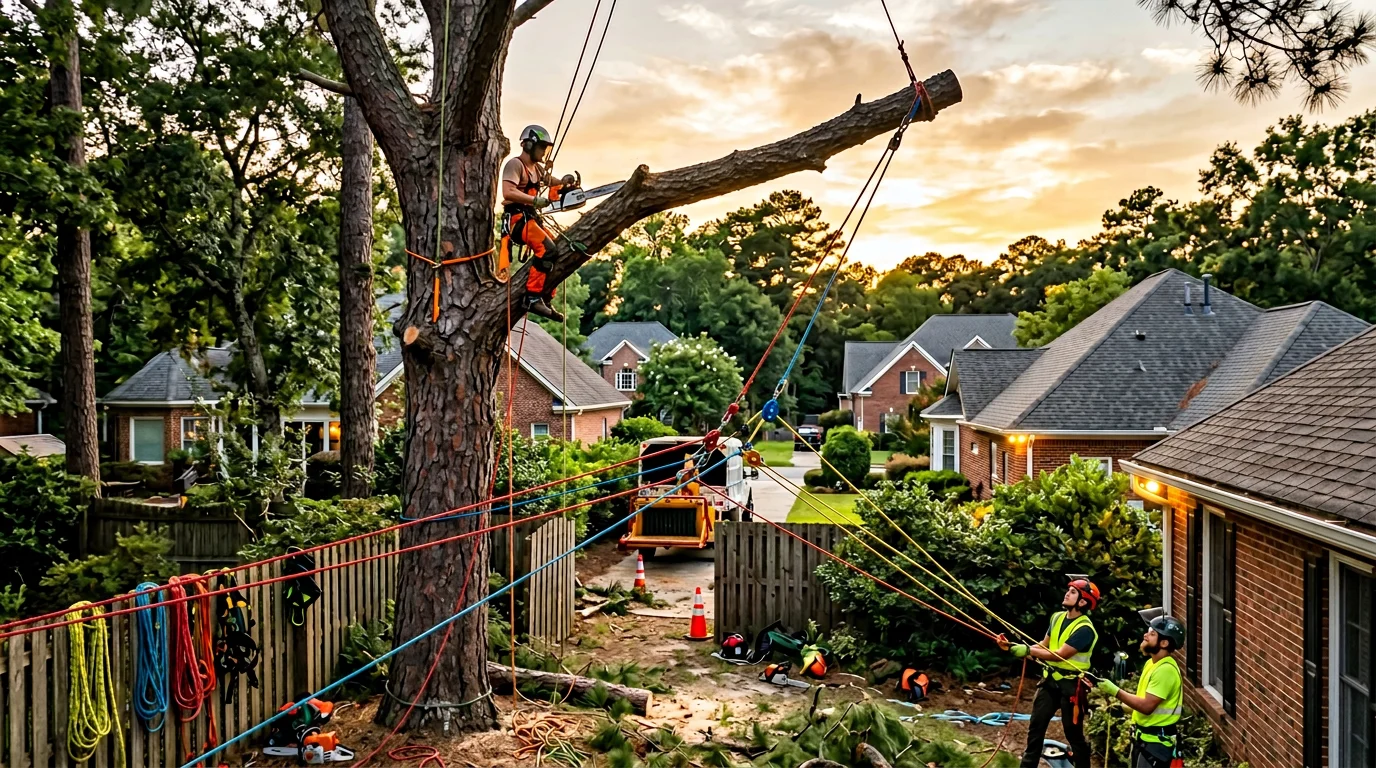
Reliable Tree Cutting & Felling
in Adams Run, SC
Professional tree cutting & felling for Adams Run homes and properties. 24/7 emergency response and careful property protection.
Tree Cutting & Felling in South Carolina
Tree cutting and felling is the controlled process of cutting a tree at its base and directing it safely to the ground within a predetermined fall zone. It is used when a tree has sufficient open space around it for a controlled ground-level fell. South Carolina Tree Removal Experts provides professional tree cutting and felling across all of South Carolina. Free estimates available. Call (888) 643-4199.
Tree cutting and felling is the foundation of professional tree removal work — and it is also one of the most dangerous jobs a property owner can attempt without the proper training, experience, and equipment.
A tree that falls in the wrong direction, at the wrong angle, or at an unexpected moment can cause catastrophic damage to your home, your neighbor’s property, underground utilities, and anyone standing in the wrong place at the wrong time.
South Carolina Tree Removal Experts has been providing professional tree cutting and felling services across South Carolina for 38 years. O
ur experienced local crew approaches every felling job with the same structured safety process, professional-grade equipment, and commitment to precision that have kept our reputation intact and our clients’ properties undamaged for nearly four decades.
Whether you need a single overgrown Loblolly Pine cut down in your Greenville backyard, a stand of Sweetgums cleared from a lot in Columbia, or a large Water Oak felled safely away from structures on a rural property outside Myrtle Beach, South Carolina Tree Removal Experts has the experience, the equipment, and the professional judgment to get the job done right the first time.
Tree cutting and felling done correctly is efficient, precise, and leaves your property clean and clear.
Tree cutting and felling done incorrectly are among the most expensive and potentially dangerous mistakes a South Carolina homeowner can make. The difference between those two outcomes comes down entirely to who is holding the saw.
If you need professional tree cutting and felling anywhere in South Carolina, call South Carolina Tree Removal Experts today at (888) 643-4199 for a free, no-obligation estimate.
Call (888) 643-4199 for a Free Tree Cutting & Felling Estimate — Available 24/7
What Is the Difference Between Tree Cutting and Tree Removal?
Tree cutting and tree removal are terms that South Carolina homeowners frequently use interchangeably — but they actually refer to different scopes of work, and understanding the distinction helps you know exactly what service you need and what to expect when you call a professional tree company.
South Carolina Tree Removal Experts provides both services across the entire state, and our team will always ensure you have a clear picture of exactly what your specific job entails before any work begins.
The distinction between the two terms is straightforward, but it carries real practical implications for how a job is planned, priced, and executed. Here is a clear breakdown of what each term means and how they relate to each other.
Tree Cutting and Felling — Bringing the Tree Down
Tree cutting and felling refers specifically to the act of cutting a tree at or near its base and directing it safely to the ground within a predetermined fall zone. This is the primary physical act of removing a tree from its standing position — the moment the saw meets the trunk and the tree begins its controlled descent to the ground.
Professional tree felling involves a precise sequence of cuts — a directional notch cut on the side of the tree facing the intended fall direction, followed by a back cut on the opposite side that releases the tree and allows it to fall along the planned trajectory.
The geometry of those cuts, the angle at which they are made, the depth to which they penetrate the trunk, and the timing of each cut relative to the other are all variables that determine whether the tree falls exactly where it is supposed to — and getting any one of them wrong can have serious consequences for everything in the fall zone.
Tree Removal — The Complete Service
Tree removal is the broader term that encompasses the entire scope of work involved in eliminating a tree from your property — from the initial felling or sectional cutting all the way through to the complete cleanup and haul-away of every piece of wood, every branch, and every bit of debris the operation produces.
Full tree removal also includes planning for debris cleanup and the final condition of the cut area, so you understand exactly how the space will be left when the crew is done.
When most South Carolina homeowners say they need a tree removed, they are actually describing full tree removal—the complete service that starts with bringing the tree down and ends with a clean, clear yard.
Tree cutting and felling is the first and most technically demanding phase of the complete service, and it requires the highest level of skill, experience, and professional judgment to execute safely.
Why Both Terms Matter for Search and for Planning
Understanding the distinction between these two terms is also important for practical planning. A property owner who needs a tree cut down in an open rural lot with plenty of space around it and is comfortable handling the cleanup themselves may only need tree cutting and felling services.
A property owner who needs the full above-ground tree cleared — wood, branches, brush, and cleanup — needs full tree removal. South Carolina Tree Removal Experts offers both scopes of service across all of South Carolina, and our team will work with you during the free estimate to define exactly what scope of work your situation calls for and price it accordingly — so you get precisely the service you need without paying for anything you do not.
Does Tree Cutting Always Require Professional Equipment?
Tree cutting and felling always require professional-grade equipment, proper safety gear, and the training to use both correctly — regardless of the size of the tree or how straightforward the job might appear from the outside. A chainsaw alone does not make a person qualified to fell a tree safely, any more than owning a scalpel makes a person qualified to perform surgery.
The equipment professional tree-felling crews use goes well beyond a chainsaw — it includes wedges, felling levers, ropes and rigging for directional control, personal protective equipment rated for chainsaw work, and, in many cases, larger machinery for managing the wood once the tree is on the ground.
South Carolina Tree Removal Experts arrive at every tree cutting and felling job fully equipped for the specific demands of that job, with every piece of equipment maintained to professional standards and every crew member trained in its safe and effective use.
What Happens to the Wood After the Tree Is Cut Down?
What happens to the wood after felling depends entirely on what you, as the property owner, want to do with it and what scope of service you have engaged. If you have requested full tree removal, our crew handles complete debris cleanup and haul-away — cutting the felled tree into manageable sections, clearing all branches and brush from the work zone, and leaving your property clean and clear.
If you would like the cut wood left on your property in sections for firewood or other purposes, simply let our team know during the estimate, and we will accommodate that request as part of the job. South Carolina Tree Removal Experts is committed to delivering exactly the outcome you want from your tree cutting and felling job — and that conversation starts with a free, no-obligation estimate at your property.
Why Is Professional Tree Felling So Important?
Tree felling consistently ranks among the most dangerous occupational and recreational activities in the United States, and the statistics behind that ranking are sobering. Chainsaw injuries, unpredictable fall directions, widow-maker branches dislodged during the felling process, contact with overhead power lines, and the sudden, violent energy released when a large tree hits the ground all combine to create a hazard profile that claims lives and causes serious injuries every single year — overwhelmingly among untrained individuals attempting tree work without professional guidance.
In South Carolina, the combination of large, fast-growing tree species, clay and sandy soils that affect root stability in ways that are not always visible above ground, and a severe storm season that leaves trees in states of hidden structural compromise makes DIY tree felling even more dangerous than it might be in other parts of the country. Here is exactly why professional tree felling is not just a convenience — it is a necessity.
The Physics of a Falling Tree Are Unforgiving
A mature Loblolly Pine or Water Oak can weigh several tons, and when that mass begins moving toward the ground, it does so with a speed and force that leaves absolutely no room for error in the fall zone calculation. A miscalculated fall direction — even by a few degrees — can bring thousands of pounds of falling wood into contact with a home, a fence, a vehicle, a power line, or a person in a fraction of a second.
Professional tree fellers understand the physics of how trees fall — how the geometry of the notch cut determines the hinge that guides the fall direction, how the back cut controls the timing and speed of the fall, how the lean of the tree, the weight distribution of the canopy, and the wind conditions at the time of the fell all interact to influence where the tree ultimately lands. That understanding is built through training and experience — not through watching online videos or making assumptions about how a particular tree will behave.
The Notch Cut and Back Cut Must Be Executed With Precision
The two primary cuts in a professional tree felling operation — the directional notch cut and the back cut — must be executed with a level of precision that leaves very little margin for error. The notch cut creates the hinge that guides the tree’s fall direction, and its depth, angle, and orientation relative to the intended fall zone must be calculated accurately based on the specific characteristics of the tree being felled.
The back cut releases the tree from the stump and must be made at the correct height relative to the notch, at the correct depth to leave the right amount of holding wood in the hinge, and at the right moment in the sequence to give the feller time to move clear of the fall zone before the tree begins to move.
A back cut made too deep, too shallow, at the wrong angle, or from the wrong position relative to the notch can cause the tree to fall in an unintended direction, barber-chair — split vertically up the trunk with explosive force — or kick back toward the feller with devastating speed.
Hidden Structural Damage Makes Trees Unpredictable
South Carolina’s severe storm seasons leave many trees across the state in hidden structural compromise that is not visible from casual external inspection. A tree that survived last season’s hurricane with what appeared to be minor branch loss may have sustained deep trunk cracking, significant root system disruption, or internal wood decay that dramatically affects how it will behave during a felling operation.
A tree with hidden internal decay may not produce the clean, predictable hinge that a structurally sound tree would produce under the same cuts, meaning the fall direction control that the notch and back cut are designed to provide may be significantly compromised without the feller knowing it until the tree is already moving.
According to the National Institute for Occupational Safety and Health, tree felling is among the most hazardous occupational activities in the United States, with the majority of serious incidents involving either unexpected tree movement during the fell or contact with overhead hazards — both of which are significantly more likely when hidden structural damage is present.
Overhead Hazards Create Life-Threatening Secondary Risks
One of the most dangerous and most commonly overlooked aspects of tree felling is the risk created by overhead hazards — dead branches, previously broken limbs lodged in the canopy, and utility lines that may not be immediately visible from ground level. When a tree begins to fall, the vibration and movement dislodge overhead hazards that then fall independently of the main tree — sometimes in directions and at speeds that even an experienced feller can find difficult to anticipate.
Dead branches and lodged limbs dropped during a felling operation — widow makers — have caused fatal injuries to experienced tree workers across the country, and they represent an even greater danger to untrained individuals who may not know to look for them, may not recognize them as hazards when they do see them, or may not position themselves correctly to avoid them during the fell.
Professional tree felling crews conduct a thorough overhead hazard assessment before any cut is made, identify every potential widow maker in the canopy above the work zone, and position themselves and their crew members with those specific hazards in mind throughout the operation.
Power Line Contact Is a Potentially Fatal Risk
Trees growing near overhead power lines — a common situation across residential neighborhoods throughout Columbia, Charleston, Greenville, Myrtle Beach, and Spartanburg — create a potentially fatal electrocution risk during felling operations that untrained individuals consistently underestimate.
A tree that falls into a power line does not simply knock the line down — it can energize the surrounding ground, the fallen tree itself, and any metal equipment in contact with either, creating an electrocution hazard that extends well beyond the immediate point of contact.
According to the Occupational Safety and Health Administration, contact with overhead power lines is one of the leading causes of fatalities in tree work operations — and the risk is dramatically elevated when the work is performed by untrained individuals without proper electrical hazard awareness and clearance protocols.
South Carolina Tree Removal Experts assesses power line proximity as a primary safety consideration on every tree-cutting and felling job, and we coordinate with the relevant utility providers when line clearance or temporary de-energization is required before felling can proceed safely.
The Liability and Financial Consequences of a DIY Felling Gone Wrong
Beyond the personal safety risks, a DIY tree-felling operation that goes wrong creates a cascade of financial and legal consequences that South Carolina homeowners rarely anticipate when they decide to pick up a chainsaw.
If a self-felled tree lands on your home, your neighbor’s home, your neighbor’s vehicle, or injures a person on or near your property, the costs — structural repairs, vehicle replacement, medical bills, legal fees, and potential liability judgments — can be financially devastating.
Homeowners insurance policies frequently investigate the circumstances of tree-related damage claims, and a claim arising from an owner-performed felling operation gone wrong may be treated very differently by your insurer than a claim arising from storm damage or a professionally performed removal.
South Carolina Tree Removal Experts provides fully licensed and insured professional tree cutting and felling services across all of South Carolina — meaning that when our crew fells a tree on your property, you are fully protected by our coverage from the first cut to the final cleanup.
Don’t Risk a DIY Felling Job — Call (888) 643-4199 for a Free Professional Tree Cutting Estimate Today
When Do You Need Tree Cutting or Felling?
Tree cutting and felling is not a one-size-fits-all service — it is appropriate for specific situations where a tree needs to come down, and the property’s conditions allow for a safe, controlled ground-level fell. Understanding when tree cutting and felling is the right service for your situation helps you make an informed decision and ensures you get the most efficient and cost-effective outcome for your specific property.
South Carolina Tree Removal Experts assesses every tree cutting and felling job individually, and our team will always confirm during the free estimate whether a standard felling approach is appropriate for your situation or whether a different removal method — such as crane-assisted removal — is needed to address the specific conditions of your tree and property. Below are the most common situations where professional tree cutting and felling is the right call.
Land Clearing and Lot Preparation
One of the most common applications for tree cutting and felling in South Carolina is land clearing — the removal of multiple trees from a lot or parcel of land in preparation for construction, development, agricultural use, or general property improvement.
When a property has sufficient open space and the trees being cleared are not located close to existing structures, felling is the most efficient and cost-effective method for quickly and cleanly bringing multiple trees down.
South Carolina’s rapid population growth — particularly in the Upstate communities around Greenville and Spartanburg, the Midlands suburbs around Columbia and Lexington, and the coastal development corridors around Myrtle Beach and Charleston — means that land clearing and lot preparation are consistent and growing needs across the state.
South Carolina Tree Removal Experts has been providing professional tree cutting and felling for land-clearing projects across South Carolina for 38 years, and our crew has the experience and equipment to handle jobs of every scale efficiently and safely.
Overgrown Trees Crowding Structures or Other Trees
Trees that have grown to the point of crowding structures, encroaching on neighboring property lines, or aggressively competing with other trees or landscaping features for light and space often reach a point where removal is the most practical solution.
Overgrown Loblolly Pines, Sweetgums, and Water Oaks are among the species most commonly removed for crowding-related reasons across South Carolina residential properties — because these species grow quickly and aggressively in South Carolina’s climate and can reach problematic sizes faster than many homeowners anticipate.
When an overgrown tree has sufficient open space around it for a controlled fell — meaning the fall zone is clear of structures, vehicles, utility lines, and other obstacles — tree cutting and felling is the most straightforward and efficient removal method available.
Our crew assesses the specific conditions of the tree and the surrounding space during the free estimate and confirms whether a standard felling approach is appropriate before any work is planned or scheduled.
Trees With a Natural Lean That Can Be Used Advantageously
A tree with a natural lean is not always a hazardous tree — sometimes a lean is simply a directional growth characteristic that can actually be used advantageously in planning a felling operation. When a tree leans naturally away from structures, power lines, and other obstacles, that lean can be incorporated into the felling plan as a directional advantage — helping guide the tree’s fall toward the intended fall zone with less corrective effort required from the cutting technique alone.
Professional tree fellers know how to read a natural lean and incorporate it into their notch cut geometry and back cut approach to produce a predictable, controlled fell in the direction the tree is already inclined to go.
This approach — when the conditions are right, and the fall zone in the lean direction is clear — is one of the cleanest and most efficient felling operations our crew performs across South Carolina properties, because the tree’s natural disposition aligns with the felling plan rather than working against it.
Unwanted Trees on Rural or Large Properties
Rural and large residential properties across South Carolina frequently have trees that need to come down for a variety of practical reasons — trees that have died and need to be removed before they fall on fencing or equipment, trees that are blocking sight lines or access routes, trees that are interfering with pasture management or agricultural operations, or simply trees in locations where the property owner wants open space rather than tree cover.
On rural and large properties where open space is plentiful, and structures are not in close proximity to the trees being removed, tree cutting and felling is almost always the most practical and cost-effective removal method.
South Carolina Tree Removal Experts serves rural properties across the entire state — from large agricultural parcels in the Pee Dee region around Florence and Darlington to rural residential properties across the Upstate and Midlands — with the same professional standard of tree cutting and felling service we bring to urban and suburban jobs.
Trees Damaged by South Carolina Storms
South Carolina’s severe storm seasons — Atlantic hurricane season from June through November, powerful summer thunderstorms, and periodic winter ice storms — regularly produce trees that have been damaged to the point where removal is the safest and most practical course of action, but that still retain enough structural integrity for a controlled felling approach to be viable.
A tree that has lost major limbs in a storm, sustained trunk damage that has not yet progressed to the point of making the fall direction unpredictable, or has been partially uprooted but is still standing, may be a strong candidate for professional tree cutting and felling.
The assessment of whether a storm-damaged tree is still suitable for a conventional felling approach — or whether its structural compromise has reached the point where crane-assisted removal is the safer option — is one of the most important judgment calls our crew makes during the estimate process.
South Carolina Tree Removal Experts brings 38 years of post-storm tree assessment experience to every storm-damaged tree situation across the state, and our team will give you an honest and accurate recommendation based on the specific conditions of your tree — not on what is easiest or most convenient for our crew to execute.
Trees Interfering With Construction or Renovation Projects
Home renovations, additions, pool installations, fence replacements, driveway expansions, and other construction projects frequently require removing trees within or too close to the planned construction zone. In these situations, tree cutting and felling need to be coordinated with the broader construction timeline — completed before ground preparation begins, before foundation work is laid, or before other construction activities that the presence of a standing tree would obstruct or complicate.
South Carolina Tree Removal Experts works with South Carolina homeowners and contractors to schedule tree cutting and felling jobs that align with construction project timelines, ensuring that trees are removed efficiently and on schedule so that construction activities can proceed without delay.
Our free estimate process includes a discussion of your project timeline and any coordination requirements so that the tree removal phase of your construction or renovation project is planned and executed as smoothly and efficiently as possible.
Our Tree Cutting & Felling Process in South Carolina
Professional tree cutting and felling is not a matter of walking up to a tree, starting a chainsaw, and hoping for the best. It is a structured, methodical process that begins well before the first cut is made and continues until the last piece of debris has been cleared from your property.
South Carolina Tree Removal Experts follows a clear, proven process on every tree cutting and felling job we take on — a process refined over 38 years of professional tree work across South Carolina properties of every size, type, and complexity. Here is exactly what that process looks like from start to finish.
Step 1: Free On-Site Estimate and Initial Assessment
The process begins with a free, no-obligation on-site estimate at your property. One of our experienced team members visits your site, examines the tree or trees in question, evaluates the surrounding area and fall zone options, and provides a clear and honest assessment of what the cutting and felling job entails.
During this visit, we confirm whether a standard felling approach is appropriate for your specific tree and property conditions, or whether a different removal method is required. We take the time to answer every question you have — how the tree will be felled, where it will fall, what equipment will be used, how long the job will take, and what the cleanup process looks like — so you have a complete picture of the work before any commitment is made.
Step 2: Site Preparation and Hazard Identification
Before any equipment is unloaded and before any cuts are made, our crew conducts a thorough site preparation and hazard identification process. This involves walking the full perimeter of the work zone, identifying every overhead hazard in the canopy above the planned fall, locating all utility lines within the work area, confirming the boundaries of the fall zone, and ensuring that all people and animals are clear of the work area before operations begin.
Site preparation also includes the positioning of any ground equipment needed for the job, the establishment of a clear escape route for the feller to use once the back cut is complete, and a final crew briefing that confirms every team member understands the job plan, their specific role in the operation, and the safety protocols in place for the fell.
According to the United States Department of Labor, proper pre-job hazard assessment and site preparation are among the most critical factors in preventing serious injuries during tree felling operations — a standard our crew applies without exception on every job across South Carolina.
Step 3: Directional Notch Cut
With site preparation complete and the crew in position, the felling operation begins with the directional notch cut — the cut that establishes the hinge controlling the tree’s fall direction.
The notch is cut on the side of the tree facing the intended fall zone, and its depth, angle, and orientation are calculated based on the specific characteristics of the tree — its diameter, lean, canopy weight distribution, and wood condition.
A properly executed notch cut creates a precise hinge that holds the wood and guides the tree’s fall along the planned trajectory when the back cut releases it. The geometry of the notch is not a matter of approximation — it is a precise calculation that our experienced fellers execute with the accuracy that 38 years of professional tree cutting experience produces, because the precision of the notch cut is the single most important factor in controlling where the tree lands.
Step 4: Back Cut and Controlled Felling
With the notch cut complete and the feller’s escape route confirmed and clear, the back cut is made on the opposite side of the trunk at the correct height relative to the notch, releasing the tree from the stump and initiating the controlled fall along the planned trajectory.
The back cut is made deliberately and at a pace that allows the feller to monitor the tree’s response in real time — adjusting the cut as needed based on how the holding wood in the hinge is responding — before stepping clear along the predetermined escape route as the tree begins to move.
The moment the tree falls is the product of every preparation step that preceded it — the site assessment, the fall zone planning, the overhead hazard identification, the notch cut geometry, and the back cut execution.
When all those steps are performed correctly by an experienced professional crew, the tree lands exactly where it is supposed to, the fall zone absorbs the impact cleanly, and the property around it remains undamaged.
According to the National Safety Council, tree cutting and felling is one of the most hazardous activities a person can undertake without proper training, reinforcing why professional execution of every step in this process is non-negotiable on every job South Carolina Tree Removal Experts performs.
Step 5: Limbing and Bucking
Once the tree is on the ground, our crew begins the limbing and bucking process — removing all branches from the felled trunk and cutting it into manageable sections. Limbing is done systematically from the base of the tree toward the top, working carefully to avoid the spring energy stored in branches that are under compression or tension from the weight of the fallen tree above them.
Bucking — the process of cross-cutting the trunk into sections — is performed with cuts sized appropriately for the intended disposition of the wood, whether that is haul-away as part of a full removal service, leaving sections on the property for firewood, or processing the wood for a specific use the property owner has in mind.
Our crew handles both limbing and bucking efficiently and safely, keeping the work zone organized and clear throughout the process.
Step 6: Complete Debris Cleanup and Haul-Away
The final step in our tree cutting and felling process is the complete cleanup and haul-away of all debris from your property. All branches, brush, wood chips, and smaller debris are cleared from the work zone, loaded, and removed from your property — leaving your yard clean, clear, and ready for whatever you have planned for the space the tree once occupied.
We do not consider a tree cutting and felling job complete until your property looks the way it should — free of debris, free of hazards, and presenting the clean, open result that a professional tree removal should always deliver.
The remaining stump condition and surrounding cleanup needs are reviewed during the estimate process, so the final job plan is clear before work begins.
Serving South Carolina With 38 Years of Experience (Trust + Local Proof)
Serving South Carolina With 38 Years of Experience
Choosing the right company for tree cutting and felling on your South Carolina property is a decision that carries real consequences. A professional, experienced crew delivers a safe, precise, and clean result that protects your property and gives you complete confidence from the first cut to the final cleanup. An inexperienced or underequipped crew delivers something far less predictable — and the consequences of a tree-felling job gone wrong can be severe, expensive, and in some cases irreversible.
South Carolina Tree Removal Experts has been the trusted name in professional tree cutting and felling across South Carolina for 38 years. That trust is built on a foundation of genuine experience, professional-grade equipment, full licensing and insurance coverage, and an unwavering commitment to safety and quality on every single job we take on across this state.
38 Years of Professional Tree Cutting and Felling Experience
Very few tree removal companies in South Carolina can match the depth of our crew’s tree cutting and felling experience on every job. Over 38 years of active operation across this state, South Carolina Tree Removal Experts has felled thousands of trees on properties of every size, type, and complexity — from tight urban lots in downtown Charleston and Columbia to large rural parcels across the Pee Dee and Upstate regions, where land clearing and multi-tree felling operations are a regular part of the work we do.
That accumulated experience means our crew has encountered virtually every tree-felling scenario South Carolina properties produce — unusual lean directions, hidden structural damage from previous storm events, tight fall zones that required precise notch cut geometry, overhead hazards that demanded careful pre-fell assessment, and species-specific wood behavior that affected the cutting approach. Every one of those experiences is built into the professional judgment our crew brings to your property when you call South Carolina Tree Removal Experts for tree cutting and felling.
Fully Licensed and Insured in South Carolina
Every tree cutting and felling job carries inherent risk, and the only responsible way to take on that risk is with full licensing and insurance coverage firmly in place.
South Carolina Tree Removal Experts is fully licensed and insured in South Carolina, meaning every tree-cutting and felling job we perform is backed by comprehensive liability coverage and complete worker protection.
When an unlicensed or uninsured crew performs tree cutting and felling on your property and something goes wrong — a miscalculated fall direction, a widow maker strike, or a worker injury on your land — the financial and legal consequences can fall directly on you as the property owner.
Choosing South Carolina Tree Removal Experts means choosing a company that protects you, your property, and every person involved in the operation from the moment our crew arrives until the moment the last piece of debris leaves your yard.
Professional-Grade Equipment Maintained to the Highest Standard
The quality of the equipment used in a tree cutting and felling operation directly affects the safety and precision of every cut made during the job. South Carolina Tree Removal Experts equips every crew with professional-grade chainsaws, felling wedges, felling levers, rigging equipment, personal protective equipment, and ground machinery maintained to the highest professional standards — because equipment quality is not a preference on a tree-felling job; it is a safety requirement.
We do not send crews to South Carolina properties with undersized, poorly maintained, or inadequate equipment for the job at hand.
Every piece of equipment our crew uses is matched to the requirements of the tree being felled, inspected before use, and operated by trained professionals who understand the capabilities and limitations of every tool they use.
Free Estimates on Every Tree Cutting and Felling Job
South Carolina Tree Removal Experts offers free, no-obligation estimates on every tree cutting and felling job we take on — because we believe every South Carolina homeowner deserves complete transparency about what a job involves and what it will cost before any commitment is made.
When our team member visits your property for a tree cutting and felling estimate, you receive a genuine professional assessment from someone with 38 years of experience evaluating exactly these kinds of jobs.
You leave that estimate conversation with a clear understanding of how the tree will be felled, where it will fall, what equipment will be used, how long the job will take, and what the complete cost will be — with no hidden fees, no vague pricing ranges, and no pressure to commit on the spot.
That level of transparency and professionalism is something South Carolina Tree Removal Experts has been delivering to homeowners across this state for nearly four decades, and it is a standard we maintain on every estimate we conduct.
Serving Every Region of South Carolina
South Carolina Tree Removal Experts provides professional tree cutting and felling services across the entire state — from the Upstate cities of Greenville, Spartanburg, and Anderson to the Midlands communities of Columbia, Lexington, and Aiken, from the Lowcountry neighborhoods of Charleston, Summerville, and Hilton Head to the Grand Strand communities of Myrtle Beach, Conway, and North Myrtle Beach, and from the Pee Dee region around Florence and Darlington to the communities of Rock Hill and Fort Mill in the north.
No matter where in South Carolina your property is located, you receive the same standard of professional, safe, and thorough tree cutting and felling service that has made South Carolina Tree Removal Experts the trusted name in tree removal across this state for 38 years.
Distance from the larger metros does not mean a reduced level of service — every South Carolina homeowner deserves the best tree cutting and felling experience available, and that is exactly what our crew delivers on every single job.
A Local South Carolina Company With Deep Roots in This State
South Carolina Tree Removal Experts is not a national franchise dispatching unfamiliar contractors to your door — we are a locally owned and operated South Carolina tree removal company with nearly four decades of roots in this state and a genuine stake in the communities we serve.
Our crew members are South Carolinians who live and work in this state, understand its tree species, soil conditions, and weather patterns from direct personal experience, and take genuine pride in delivering professional results on every property they work on.
When you call South Carolina Tree Removal Experts for tree cutting and felling, you are calling a company that has been part of the South Carolina community for 38 years — a company that has built its reputation one job at a time through consistent professionalism, genuine care for every property we work on, and an unwavering commitment to the safety and satisfaction of every South Carolina homeowner we serve.
Call (888) 643-4199 Today — Free Estimates, Licensed & Insured, Available 24/7 Across All of South Carolina
Frequently Asked Questions About Tree Cutting & Felling in South Carolina
How Much Does Tree Cutting and Felling Cost in South Carolina?
Tree cutting and felling costs in South Carolina vary based on several factors, including the size and species of the tree, its location on the property, the complexity of the fall zone, and the total scope of debris cleanup and haul-away required.
A single medium-sized Sweetgum or Loblolly Pine in an open yard with a clear, uncomplicated fall zone will cost considerably less than a large Water Oak or Southern Live Oak on a more complex property that requires additional planning and crew coordination.
The most accurate way to understand the cost of your specific tree cutting and felling job is to call South Carolina Tree Removal Experts at (888) 643-4199) for a free, no-obligation on-site estimate — because every tree and every property is different, and a genuine on-site assessment always produces a more accurate and transparent cost picture than any general pricing range published online.
Is It Safe to Cut Down a Tree Yourself in South Carolina?
Tree cutting and felling is consistently ranked among the most dangerous activities a person can attempt without proper training, experience, and professional-grade equipment. Chainsaw injuries, unpredictable fall directions, widow-maker branches dislodging from the canopy during the fell, contact with overhead power lines, and the sudden, violent energy of a large tree hitting the ground all create a hazard profile that results in serious injuries and fatalities every year, overwhelmingly among untrained individuals attempting tree work without professional guidance.
Beyond the personal safety risk, a DIY felling operation that goes wrong in South Carolina can cause catastrophic damage to your home, your neighbor’s property, underground utilities, and parked vehicles — damage that your homeowners’ insurance may not cover if it results from an owner-performed operation.
South Carolina Tree Removal Experts strongly recommends that every tree cutting and felling job on your South Carolina property be performed by a licensed, insured, and experienced professional crew — and we offer free estimates to make that professional service as accessible and straightforward as possible.
How Do Professionals Decide Which Direction to Fell a Tree?
Professional tree fellers determine the intended fall direction based on a comprehensive assessment of several interacting factors — the natural lean of the tree, the weight distribution of the canopy, the location of structures, utility lines, vehicles, and other obstacles within the potential fall zone, the condition of the wood and root system, and the wind conditions at the time of the fell. The goal is to identify a fall zone that is clear of obstacles, and for the tree’s own natural characteristics — its lean, its canopy weight — to be either aligned with or effectively managed through precise notch-cut geometry and back-cut technique.
According to the Forest Resources Association, proper fall zone assessment and directional cutting technique are the most critical factors in safe tree felling operations — a standard that South Carolina Tree Removal Experts applies to every single tree cutting and felling job we perform across the state.
Our experienced fellers make fall direction decisions based on decades of hands-on experience reading trees and properties across South Carolina, and that experience is what consistently produces controlled, precise, and property-safe felling outcomes on every job we take on.
Do I Need a Permit to Cut Down a Tree on My Property in South Carolina?
Permit requirements for tree cutting and removal in South Carolina vary significantly by municipality, county, and, in some cases, the specific species and size of the tree. Some South Carolina cities and counties — particularly in the Charleston, Columbia, and Greenville areas — have local tree ordinances that regulate or restrict the removal of certain protected, heritage, or significant tree species regardless of whether the tree is on private property.
We strongly recommend checking with your local city or county planning and zoning office before scheduling the removal of any tree that may be protected under local ordinances — particularly large, mature trees of species commonly protected under South Carolina municipal ordinances, such as Southern Live Oak, Bald Cypress, and Sabal Palmetto.
South Carolina Tree Removal Experts is familiar with tree removal regulations across the state, and our team can help guide you toward the right local resources during the estimate process so you have complete clarity on any permit requirements before work begins.
Get Your Free Tree Cutting & Felling Estimate Today
A tree that needs to come down on your South Carolina property is not a problem that gets easier or safer the longer it sits. Every storm season that passes with an unwanted, overgrown, or structurally compromised tree still standing is another season of unnecessary risk — to your home, your family, your neighbors, and everyone who spends time on or near your property.
South Carolina Tree Removal Experts is ready to help you solve that problem today. We have been the trusted name in professional tree cutting and felling across South Carolina for 38 years, and every job we take on is backed by full licensing and insurance coverage, a detailed free estimate, professional-grade equipment, and a crew with the experience, skill, and professional judgment to fell any tree safely, precisely, and without damage to your property.
Tree cutting and felling done right is one of the cleanest and most satisfying results a South Carolina property owner can experience — a tree that was creating risk, blocking space, or simply not belonging where it stood, gone cleanly and efficiently, with your yard left clear and ready for whatever comes next.
That is the result South Carolina Tree Removal Experts has been delivering to homeowners across this state for nearly four decades, and it is the result we are ready to deliver for you.
Do not attempt a DIY felling job that puts your property, your family, and your neighbors at risk. Do not leave an unwanted or problematic tree standing through another South Carolina hurricane season.
Call South Carolina Tree Removal Experts now and let our experienced local crew assess your situation, develop a safe, precise felling plan, and provide the complete, transparent estimate you need to move forward with total confidence.
We serve all of South Carolina — from Columbia, Charleston, Greenville, and Myrtle Beach to Spartanburg, Rock Hill, Summerville, Florence, Hilton Head, Anderson, Aiken, Lexington, and every community across the state — with the same standard of professional, safe, and thorough tree cutting and felling service on every single job.
Call (888) 643-4199 now for your free tree cutting and felling estimate — available 24 hours a day, 7 days a week, across all of South Carolina.
Need Tree Cutting & Felling Fast?
Our local crews are currently serving Adams Run.
Frequently Asked Questions in Adams Run
Area Service Info
Nearby Communities We Also Serve
Local tree removal and land clearing support for Charleston County and surrounding areas.
Ready to Secure Your Adams Run Property?
Our experienced crews provide safe removal planning and careful execution for Adams Run property owners. Schedule your free evaluation today.