
Reliable Tree on House Removal
in Fairview crossroads, SC
Professional tree on house removal for Fairview crossroads homes and properties. 24/7 emergency response and careful property protection.
If a tree has fallen on your home in South Carolina, the danger does not end when the tree stops moving. South Carolina Tree Removal Experts specializes in safe, precision tree-on-house removal — protecting your structure throughout the entire process. Available 24/7 across all of South Carolina. Call (888) 643-4199) immediately for emergency response.
A Tree on Your Roof Is a Crisis — Not a Morning Problem
It is the middle of the night, and a sound woke you up — not a gradual creaking but a sudden, violent crash that shook the walls and rattled the windows. By the time you reach the hallway, you can already hear rain coming through a part of your house where rain should never be.
A tree is on your roof. In that moment the questions come fast and hard. Is the structure safe? Do you stay or leave? Who do you call at this hour?
These are not questions that can wait until morning — and they are not questions you should be trying to answer alone. A tree on your home is the single most serious tree emergency a South Carolina homeowner can face.
It combines the immediate physical danger of an unstable, heavy object resting on your structure with the compounded threats of water intrusion, potential roof collapse, and electrical hazards. All of these are developing simultaneously — and all of them get worse with every hour that passes.
South Carolina’s storm seasons make this scenario more common than most homeowners want to believe. Every hurricane season, every major thunderstorm event, and every significant Upstate ice storm produces tree-on-house emergencies across the state.
The trees are large, the homes are close, and when a saturated Loblolly Pine or a storm-stressed Live Oak finally gives way, the distance between the tree and the roofline is often measured in feet rather than yards. South Carolina Tree Removal Experts has been responding to tree-on-house emergencies across this state for 38 years — and we know exactly what to do.
What a Tree on Your House Is Actually Doing While It Sits There
The moment a tree comes to rest on your home, a clock starts running. Every hour that tree stays in place, the damage underneath it grows — and in South Carolina’s humid climate, it grows fast.
Here is exactly what is happening to your home while that tree sits waiting for removal:
Water intrusion begins immediately. The moment a tree breaches your roof deck, rain, humidity, and condensation begin finding their way into your home’s structure. South Carolina’s average annual rainfall of 44 to 55 inches means there is almost always moisture in the air — and a compromised roof gives it direct access to your insulation, framing, drywall, and electrical systems.
Structural integrity deteriorates with every passing hour. A large tree resting on a roof is applying continuous downward pressure to a structure that was never designed to carry that load. Roof rafters, ridge beams, and ceiling joists absorb that pressure until they cannot — and secondary structural failure can happen without warning, even after the initial crash has passed.
Mold growth begins within 24 to 48 hours. South Carolina’s humidity creates ideal mold conditions the moment moisture finds its way into wall cavities and insulation. What starts as water intrusion through a breached roof can become a full mold remediation situation within two days — adding thousands of dollars to your recovery costs.
Electrical hazards develop silently. A falling tree can sever, pinch, or expose wiring running through your attic, walls, or exterior — creating live electrical hazards that are invisible from the outside. If a tree has compromised your roof structure, there is a real possibility of electrical danger inside the affected area that only a professional assessment can identify and address safely.
The longer the tree sits, the more your insurance claim is at risk. According to the SC Emergency Management Division, homeowners are expected to take reasonable steps to mitigate storm damage as promptly as possible following a weather event. Insurers apply the same standard — a delayed response that allows preventable water damage or structural deterioration to develop can directly impact your claim and leave you personally responsible for damage that would otherwise have been covered.
Secondary structural collapse becomes a real risk. The USDA Forest Service identifies trees resting on structures as among the highest-risk post-storm scenarios for both personal injury and property damage. A roof section that has been compromised by a fallen tree can collapse further — particularly when additional rain adds weight to an already stressed structure.
The bottom line is straightforward. Every minute a tree sits on your home, the list of problems it is creating gets longer and more expensive. Fast, professional removal is not just the right response — it is the only response that stops the damage from compounding.
How South Carolina Tree Removal Experts Remove a Tree From Your Home
Removing a tree from a house is the most technically demanding emergency removal our crews perform. It requires a completely different approach from standard fallen tree removal — because the structure beneath the tree must be protected at every step of the process.
We do not drag. We do not push. We do not cut and drop. Every section of tree that comes off your home is lifted, controlled, and removed with precision — because anything less risks turning a manageable situation into a catastrophic one.
Why Tree-on-House Removal Demands a Different Approach
When a tree falls in an open yard, the primary concern is safe cutting and debris removal. When a tree falls on a home, the primary concern shifts entirely — now the goal is removing the tree without adding any additional stress, pressure, or movement to the structure it is resting on.
Every cut we make on a tree-on-house removal is planned in advance. We identify exactly how the tree’s weight is distributed across your roof before the first cut is made — because removing the wrong section first can shift that weight in ways that cause immediate further damage.
Our Tree-on-House Removal Process — Step by Step
Step 1 — Immediate Scene Assessment Our crew arrives and evaluates the full situation before anything else happens. We assess power line contact, structural load distribution, roof integrity, and the safest approach sequence for your specific situation.
Step 2 — Safety Determination. We advise you clearly on whether the affected area of your home is safe to occupy while we work. If there is any doubt about structural integrity or electrical safety, we will tell you directly — your family’s safety comes before the removal timeline.
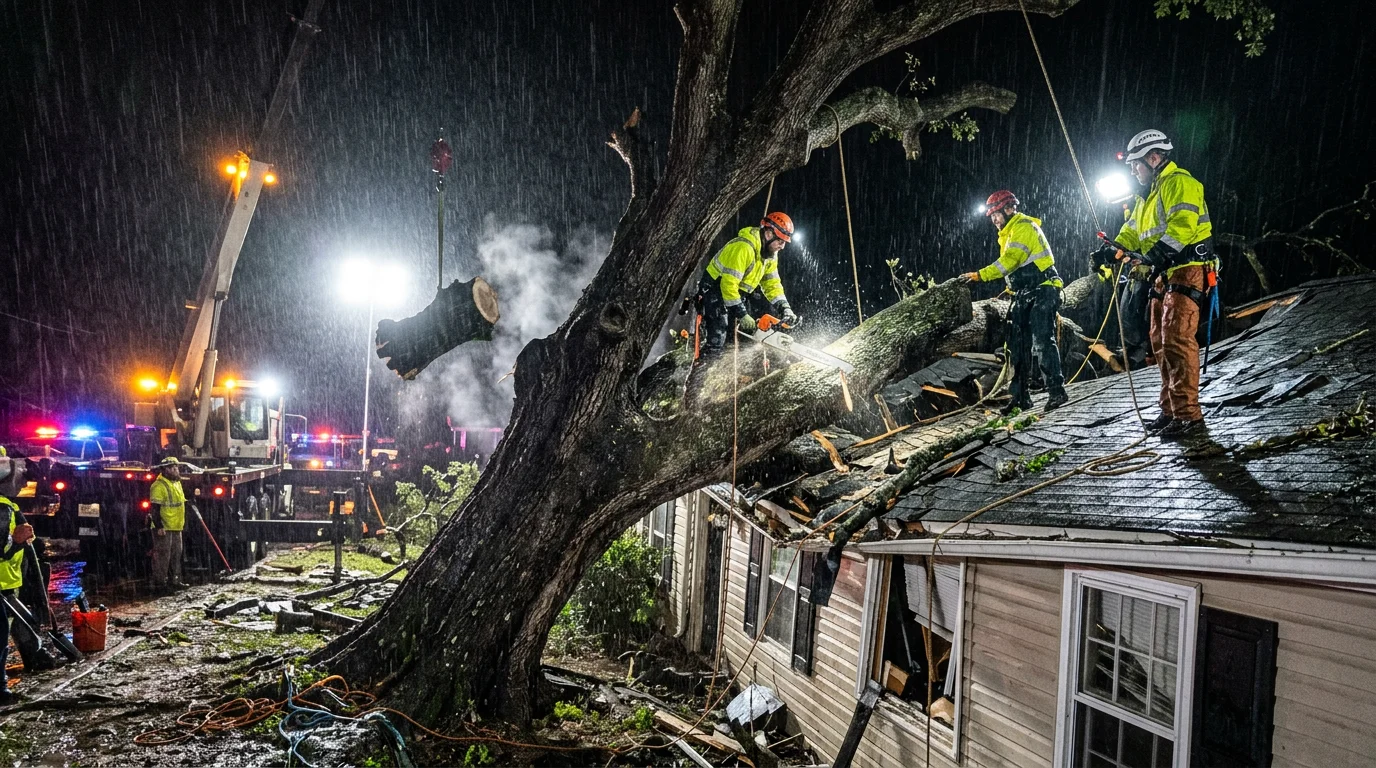
Step 3 — Crane Positioning When Required For large trees or situations where ground-based cutting would add unacceptable risk to your structure, we position our crane before any cutting begins. The crane allows us to lift tree sections vertically away from your roof — eliminating the lateral movement that causes secondary roof damage.
Step 4 — Precision Sectional Removal Working from the outermost sections of the tree inward toward the point of roof contact, we remove the tree piece by piece. Each section is controlled — either rigged for crane lift or cut to a size and position that allows safe ground removal without roof contact.
Step 5 — Point-of-Contact Removal The section of the tree in direct contact with your roof is the last and most critical removal step. We approach this section with maximum precision — using rigging, crane assistance, and careful cutting angles to lift it cleanly away from your roof surface without dragging across shingles, flashing, or structural elements.
Step 6 — Full Debris Clearance Every branch, every limb, and every piece of debris comes off your roof and your property completely. We inspect the roof surface and surrounding areas for debris before we consider the job finished.
Step 7 — Roof Tarp Installation on Request If your roof has been breached and structural repairs cannot begin immediately, we can install a heavy-duty protective tarp over the damaged area before we leave — protecting your home from further water intrusion until your roofing contractor arrives. Ask about this service when you call.
Crane-Assisted Removal — The Right Tool for the Most Critical Jobs
Crane-assisted tree removal is not always necessary — but on tree-on-house jobs, it is often the difference between a clean removal and one that causes additional damage. Our crane allows us to lift entire tree sections straight up and away from your roof rather than relying on directional felling that puts lateral pressure on your structure.
After 38 years of tree-on-house removals across South Carolina, our crews know exactly when a crane is necessary — and we never hesitate to deploy one when the situation calls for it. Your home is worth doing it right.
We Work Around Your Roofing and Repair Contractors
A tree-on-house emergency typically involves multiple contractors — tree removal, roofing repair, potentially structural assessment, and interior remediation. South Carolina Tree Removal Experts coordinates smoothly with whatever other contractors you have engaged, ensuring our removal work creates the cleanest possible starting point for the repair work that follows.
We document the removal thoroughly — photographs, removal records, and damage assessment notes — so every contractor coming behind us has a clear picture of what was removed, what was found, and what the structure looks like post-removal. That coordination saves you time, reduces confusion, and helps your recovery move forward as efficiently as possible.
The Experience and credentials That Matter Most When a Tree Is on Your Home
When a tree is resting on your roof, the company you call is making decisions that directly affect the structural future of your home. The wrong cut at the wrong moment, the wrong equipment for the situation, or the wrong assessment of a tree’s weight distribution — any of these mistakes can turn a serious situation into a devastating one.
This is not the moment to call a company you are not absolutely certain about. It is the moment to call the company with 38 years of experience doing exactly this — South Carolina Tree Removal Experts.
38 Years of High-Stakes Tree Removal in South Carolina
Nearly four decades of tree removal in South Carolina mean our crews have performed tree-on-house removals in every scenario this state’s long, active storm seasons can produce. They have lifted Loblolly Pines off rooftops in Columbia after summer thunderstorms, removed hurricane-damaged Live Oak sections from Lowcountry homes in Charleston and Beaufort, and cleared ice-loaded Sweetgum limbs from Upstate residences in Greenville and Spartanburg.
That accumulated experience is not theoretical — it is practical, real-world knowledge built job by job over 38 years of showing up to the most difficult tree removal situations South Carolina homeowners face. Our crews no longer encounter new scenarios on tree-on-house jobs. They have seen it all — and they know exactly how to handle it.
Experience at this level means our crew lead reads a tree-on-house scene in minutes — identifying the weight distribution, the safest cutting sequence, the equipment required, and the risks that need to be managed before a single tool is deployed. That assessment capability is the most valuable thing we bring to a tree-on-house emergency, and it only comes from decades of doing this work correctly.
Fully Licensed and Insured — Critical on Every Tree-on-House Job
Tree-on-house removal carries more liability exposure than almost any other residential tree service. If an uninsured or underinsured crew causes additional structural damage during removal — a miscut that shifts the tree further into the roof, a section that drops instead of lifts, equipment that contacts and damages exterior walls — the financial consequences for the homeowner can be severe.
South Carolina Tree Removal Experts carries full licensing and comprehensive insurance coverage on every job we perform in South Carolina. Our coverage protects your home, your structure, and our crew throughout the entire removal process — from the moment we assess the scene to the moment the last piece of debris leaves your property.
Before you allow any crew to begin work on a tree that is resting on your home, verify their licensing and insurance status. A professional, legitimate tree service will provide proof without hesitation. We always do — because we understand exactly what is at stake when we are working on your most valuable asset.
We Have Worked Alongside South Carolina’s Insurance Industry for 38 Years
A tree on your home almost always involves an insurance claim — and how that claim is handled from the very beginning affects how smoothly and completely your recovery proceeds. South Carolina Tree Removal Experts has supported homeowners through the insurance process after tree-on-house events more times than we can count over nearly four decades in this state.
We document everything from arrival through completion — pre-removal damage photography, removal process records, post-removal structural condition assessment, and a complete written account of the work performed. That documentation package is specifically structured to give your insurance adjuster exactly what they need to process your claim efficiently and completely.
We also understand the importance of acting quickly from an insurance perspective. Insurers expect homeowners to mitigate damage promptly — and our 24/7 availability means you can have a professional crew on-site and working as fast as the safety situation allows, demonstrating the prompt mitigation response your policy requires.
Transparent Pricing — No Blank Checks in an Emergency
Tree-on-house removal is a high-stakes, emotionally charged situation — and some contractors use that stress to justify unclear, inflated, or post-work pricing. We do not operate that way — and we never have.
South Carolina Tree Removal Experts provides a clear, detailed estimate before any tree-on-house removal work begins. We walk you through the full scope of the job — the equipment required, the removal approach, the cleanup included, and the complete cost — before our crew starts. You agree to the estimate, we do the work, and the final bill matches what we quoted.
Emergency response does not mean emergency pricing. Fair, transparent pricing is a standard we have maintained for 38 years — because a company that genuinely delivers quality work does not need to hide its pricing.
Our Reputation Is Built on Getting the Hardest Jobs Right
There is a particular kind of professional satisfaction that comes from completing a tree-on-house removal perfectly — the tree lifted cleanly away, the roof surface protected, the structure stabilized, the homeowner’s crisis resolved. It is the hardest job we do, and the one we are proudest of doing well.
South Carolina Tree Removal Experts has built 38 years of reputation on getting the hardest jobs right. Every tree-on-house removal we perform gets our full attention, our best equipment, and the complete depth of experience our crews have accumulated over nearly four decades in this state. Your home deserves nothing less — and we deliver nothing less.
Tree-on-House Emergencies Across South Carolina — We Know This State’s Risk Landscape
South Carolina is one of the most beautifully treed states in the country — and one of the most storm-exposed. That combination means tree-on-house emergencies are not rare, isolated events here. They are a predictable consequence of living in a state where mature, large-canopy trees grow close to homes and storm seasons are long, active, and powerful.
After 38 years responding to tree-on-house emergencies across every region of South Carolina, we know exactly where the risk is highest, which species cause the most damage, and what homeowners in each part of the state are most likely to face when a major storm moves through.
Why South Carolina Homes Are Particularly Vulnerable to Tree Strikes
South Carolina’s residential development patterns create a tree-on-house risk profile that is higher than most homeowners fully appreciate. Older neighborhoods in Columbia, Charleston, Greenville, and Spartanburg were developed with large, mature trees planted close to homes — trees that were saplings when the houses were built and are now towering specimens whose canopy spreads directly over rooflines.
Lowcountry communities in particular are developed within and around existing tree canopy — Live Oaks, Loblolly Pines, and Water Oaks that were there long before the homes were built and often stand within falling distance of multiple structures simultaneously. The same natural beauty that makes Charleston, Beaufort, and Summerville so visually distinctive also creates a significant tree-on-house risk every single storm season.
South Carolina’s soil conditions compound that risk further. The clay-heavy soils of the Midlands and the sandy coastal soils of the Lowcountry both pose root-anchoring challenges that become critical during storm events. A tree that has stood without issue for thirty years can lose its root anchor in a single saturated storm event — and when it goes, the nearest roofline is often directly in its path.
The Species Behind South Carolina’s Tree-on-House Emergencies
Different tree species create different tree-on-house scenarios — and knowing which species you are dealing with shapes the entire approach our crews take to removal.
Loblolly Pine is the species behind the majority of tree-on-house calls we respond to across the Midlands and Pee Dee regions of South Carolina. Its height — commonly 60 to 100 feet at maturity — means that when it falls, it falls far and hits hard. A full-canopy Loblolly Pine on a residential roofline is one of the most significant structural loads a South Carolina home will ever experience, and removing it safely requires the right equipment and experience.
Southern Live Oak produces the most challenging tree-on-house removals we encounter in the Lowcountry. Live Oak limbs are extraordinarily dense and heavy — a single major limb can weigh thousands of pounds — and their sprawling canopy structure means that limb failures during hurricane or tropical storm events often land directly on structures below. Crane-assisted removal is almost always the correct approach for a Live Oak limb on a Lowcountry roofline.
Water Oak is the species most commonly associated with root-failure tree-on-house events across South Carolina’s Midlands and Lowcountry. Water Oaks are prone to internal decay that develops invisibly over the years — the tree looks healthy from the outside right up until the moment the root system gives way and the entire tree tips onto whatever is closest. In densely treed Columbia, Lexington, and Summerville neighborhoods, that is often a home.
Sweetgum trees produce some of the most common limb-strike roof damage calls across South Carolina’s suburban neighborhoods. Sweetgum limbs are heavy, break cleanly at the attachment point during high wind events, and fall with significant force — causing localized but serious roof damage that requires immediate professional response.
Tulip Poplar grows tall and fast across the Upstate and Midlands — and its combination of height and relatively brittle wood makes it a significant tree-on-house risk during ice storms and high wind events across Greenville, Spartanburg, and Anderson.
Regional Tree-on-House Risk Across South Carolina
Every region of South Carolina has its own tree-on-house story — and our crews know each one from 38 years of firsthand experience.
In the Lowcountry, Charleston, Mount Pleasant, Summerville, Beaufort, Bluffton, and Hilton Head Island face the most direct hurricane and tropical storm exposure of any region in the state. The combination of large Live Oaks, tall Loblolly Pines, dense residential canopy cover, and annual hurricane season risk makes tree-on-house emergencies a regular feature of Lowcountry storm recovery.
Our crews respond to Lowcountry tree-on-house calls every single storm season — and we know the region’s trees, its homes, and its soil conditions as well as anyone working in this state.
In the Midlands, Columbia, Lexington, West Columbia, Irmo, and Blythewood sit in a corridor that combines dense residential tree canopy with some of the most intense summer thunderstorm activity in the Southeast. Water Oak root failures and Loblolly Pine strike events are the dominant tree-on-house scenarios across the Midlands — and our crews are on-call year-round to respond when Columbia and Lexington homeowners need us most.
In the Upstate, Greenville, Spartanburg, Anderson, and surrounding communities face a tree-on-house risk driven primarily by ice storms and severe wind events. Ice-loaded Sweetgums and Tulip Poplars coming down on Upstate rooftops are among the most common calls our crews respond to outside of hurricane season — and the weight of an ice-covered tree on a residential roof creates structural urgency that demands immediate professional response.
Along the Grand Strand, Myrtle Beach, North Myrtle Beach, Conway, and Surfside Beach homeowners and vacation property owners face coastal storm exposure that makes tree-on-house emergencies a genuine seasonal concern. Sandy coastal soils provide limited root anchoring, hurricane season brings direct Atlantic storm exposure, and the density of residential and vacation rental development means that a single fallen tree can affect multiple properties simultaneously.
Across the Pee Dee region, homeowners in Florence, Darlington, Hartsville, and Marion face Loblolly Pine and Water Oak strike events driven by the region’s heavy rainfall and an active spring and summer storm season. Pee Dee tree-on-house calls are a consistent part of our emergency response calendar — and our crews know the region’s tree landscape and storm patterns as well as any in the state.
No matter which region of South Carolina you call home — no matter which tree fell and no matter which part of your home it landed on — South Carolina Tree Removal Experts has the experience, the equipment, and the local knowledge to remove it safely and protect what remains of your structure in the process.
Tree on House Removal FAQs
The questions South Carolina homeowners ask us most when a tree has fallen on their home — answered directly, so you know exactly what to expect when you call.
What Should I Do Immediately If a Tree Falls on My House in South Carolina?
The very first priority is the safety of every person in the home — not the tree, not the roof, and not the insurance claim. Move everyone away from the affected area of the house immediately, and if the structural damage is significant or you have any doubt about the integrity of the roof or ceiling above you, evacuate the home entirely until a professional crew has assessed the situation.
If the fallen tree has any contact with electrical wiring — interior or exterior — treat the entire affected area as a live electrical hazard, contact your utility provider immediately, and keep everyone well clear until they confirm the lines are safe.
Once everyone is safely away from the hazard, photograph the damage from a safe distance for your insurance claim and call South Carolina Tree Removal Experts at (888) 643-4199 — we are available 24 hours a day, 7 days a week, and we will advise you on the next steps while our crew is in transit.
Is It Safe to Stay in My Home After a Tree Falls on the Roof?
Whether it is safe to remain in your home depends entirely on the extent of the structural damage and where the tree has come to rest. If the tree has breached the roof deck and is exerting direct downward pressure on the ceiling structure below, our strong recommendation is to vacate the affected area — and, in cases of significant structural compromise, to leave the home entirely until professional removal and structural assessment have been completed.
Secondary structural failure — ceiling collapse, further roof deck failure, or wall compromise — can occur without warning when a large tree is bearing down on a residential structure. Do not rely on visual inspection from below to determine whether the structure above you is safe — call South Carolina Tree Removal Experts at (888) 643-4199 and let our experienced crew assess the situation upon arrival.
Will My Homeowners Insurance Pay for Tree-on-House Removal in South Carolina?
In most cases, yes — homeowners’ insurance policies in South Carolina typically cover tree removal when the tree has fallen on and damaged a covered structure, such as your home, garage, or other insured outbuilding. The removal cost, structural repair costs, and interior damage remediation are commonly covered under the dwelling protection portion of a standard homeowners policy, subject to your deductible and specific policy terms.
South Carolina Tree Removal Experts documents the full removal process — pre-removal damage photography, removal records, and post-removal structural condition notes — giving your insurance adjuster exactly what they need to process your claim efficiently. Contact your insurer as soon as possible after the event and begin the claims process immediately — prompt notification and documented mitigation efforts are both important to a smooth claim outcome.
How Do You Remove a Tree From a Roof Without Causing More Damage?
The answer is precision, planning, and the right equipment — applied in the right sequence. Our crew assesses the tree’s weight distribution across your roof structure before making any cuts, identifying exactly which sections need to be removed to avoid shifting the remaining load and causing further damage.
We work from the outermost sections of the tree inward toward the point of roof contact, removing pieces by piece in a controlled sequence rather than attempting to move the tree as a whole. For large trees or situations where ground-based cutting creates unacceptable risk to your structure, we deploy our crane — lifting sections vertically away from your roof rather than dragging or dropping them across your shingles and framing.
The final section — the point of direct roof contact — is the last thing we remove and the step we approach with the greatest precision, using rigging and careful cutting angles to lift it cleanly away from your roof surface without adding any lateral movement to the structure.
How Quickly Can You Respond to a Tree-on-House Emergency in South Carolina?
South Carolina Tree Removal Experts responds to tree-on-house emergencies 24 hours a day, 7 days a week — including overnight, on weekends, and during active storm recovery periods. The moment you call (888) 643-4199), we begin coordinating crew dispatch to your location — there is no answering service, no callback queue, and no waiting until business hours to get a real response.
Actual arrival time depends on your location within South Carolina and the volume of simultaneous emergency calls in your area following a major storm event, but tree-on-house situations are our highest-priority dispatch—we treat them with the urgency they deserve and get crews moving toward your property as fast as conditions safely allow.
Should I Try to Cover the Roof Myself Before the Crew Arrives?
We strongly advise against attempting to access your roof or the area directly beneath the tree before our crew arrives — particularly at night, in wet conditions, or when the roof’s structural integrity is uncertain.
A compromised roof surface is extremely dangerous to walk on, and the presence of a large tree adds unpredictable instability to any structure it supports. If water intrusion is an immediate concern and conditions are safe, placing buckets or moving valuables away from the affected interior area is a reasonable precaution — but leave roof access entirely to our professional crew.
We can install a heavy-duty protective tarp over the damaged roof area as part of our removal service, protecting your home from further water intrusion until your roofing contractor arrives — just ask about this when you call.
Tree on Your House in South Carolina? Call Us Right Now — We Are Ready
There is no tree emergency more urgent than a tree on your home. Every minute it sits there, the water intrusion deepens, the structural load continues, and the recovery becomes more complicated and more expensive.
South Carolina Tree Removal Experts has been removing trees from South Carolina homes for 38 years — safely, precisely, and with the full protection of your structure as our highest priority throughout every single job. We answer when you call, dispatch immediately, arrive equipped for the most technically demanding removal scenarios, and do not leave until your home is clear, your roof is protected, and your property is safe.
From the Lowcountry coast to the Upstate foothills — from Charleston and Hilton Head to Greenville and Spartanburg — we are South Carolina’s most experienced tree-on-house removal company. Thirty-eight years of the hardest jobs done right. Thirty-eight years of South Carolina homeowners trusting us with their most valuable asset.
Your home cannot wait. Neither should you.
📞 Call (888) 643-4199 — 24/7 Tree-on-House Emergency Removal Across South Carolina Free estimates. Licensed and insured. Crane-assisted removal available. No voicemail. No waiting.
South Carolina Tree Removal Experts — protecting South Carolina homes since 1986.
Need Tree on House Removal Fast?
Our local crews are currently serving Fairview crossroads.
Frequently Asked Questions in Fairview crossroads
Area Service Info
Related Services
Nearby Communities We Also Serve
Local tree removal and land clearing support for South Carolina and surrounding areas.
Ready to Secure Your Fairview crossroads Property?
Our experienced crews provide safe removal planning and careful execution for Fairview crossroads property owners. Schedule your free evaluation today.