Reliable Tree Removal
in Hollywood, SC
Professional tree removal for Hollywood homes and properties. 24/7 emergency response and careful property protection.
Tree Removal in South Carolina
When a tree on your property starts showing signs of trouble — a heavy lean after last night’s storm, a trunk that’s gone hollow, or dead branches dropping without warning — the situation can feel overwhelming. You know something needs to be done, but you’re not sure who to call, how urgent it really is, or whether the job can even be done safely without tearing up your yard in the process.
That’s exactly where South Carolina Tree Removal Experts comes in.
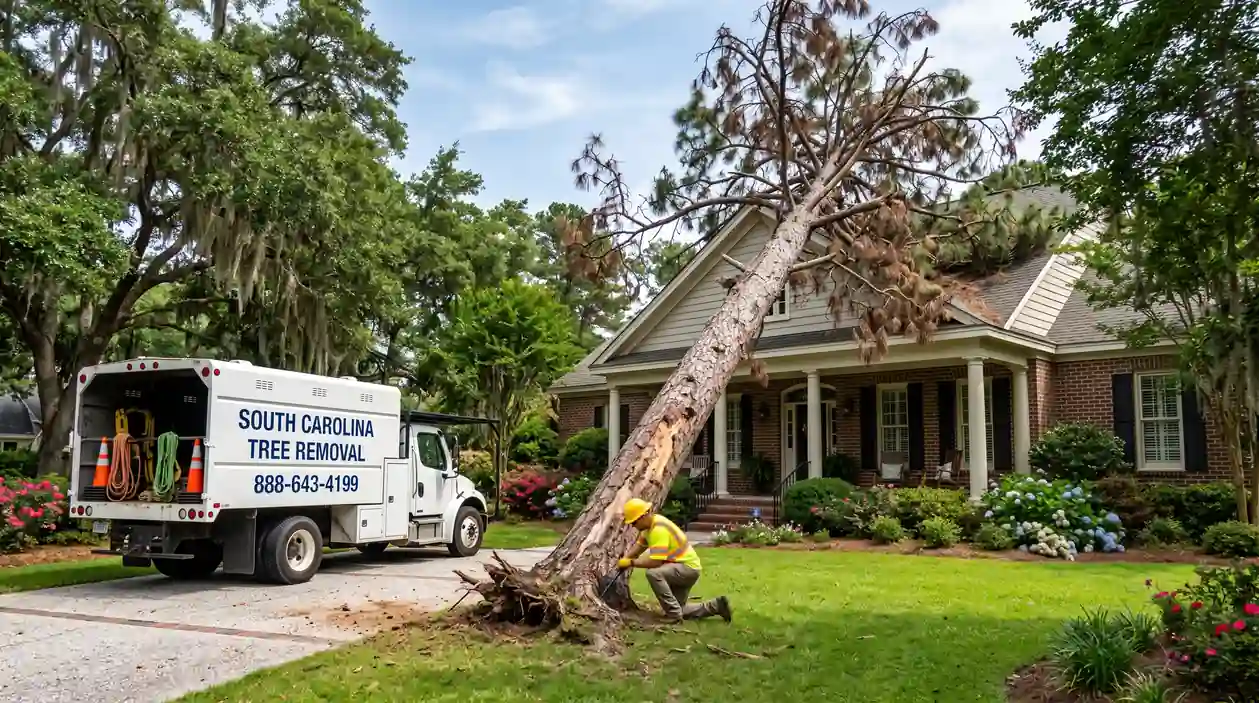
We’ve been providing professional tree removal in South Carolina for over 38 years, serving homeowners, landlords, and property managers from the Upstate to the Lowcountry. Whether you’re dealing with a dead Loblolly Pine that’s been slowly leaning toward your fence line, a massive Water Oak overhanging your roof, or storm damage that left a tree in a dangerous and unpredictable condition — our experienced, local crew has seen it all and handled it all, safely and efficiently.
Tree removal isn’t a job for just anyone with a chainsaw. It requires training, the right equipment, a clear understanding of how trees behave under stress, and the kind of experience that only comes from decades of work in the field. A tree removed incorrectly can cause serious damage to your home, your vehicles, your landscaping — and most importantly, to the people around it. That’s a risk no South Carolina homeowner should have to take.
South Carolina Tree Removal Experts is fully licensed and insured in South Carolina, and every job — whether it’s a small backyard removal or a large crane-assisted operation — is handled with the same commitment to safety, professionalism, and care for your property. We offer free estimates on all tree removal work, and our team is available 24 hours a day, 7 days a week for emergency situations that simply cannot wait.
When you need tree removal in South Carolina done right the first time, there’s one number to call: (888) 643-4199.
When Does a Tree Need to Be Removed?
Trees are one of the most valuable features of any South Carolina property. They provide shade during the brutal summer heat, add beauty and curb appeal, and can even increase your home’s market value. But trees are also living structures — and like any living thing, they age, weaken, get damaged, and eventually reach a point where keeping them standing becomes more dangerous than taking them down.
The challenge for most homeowners is knowing when that point has arrived. Not every struggling tree needs to come down immediately, but some absolutely do — and waiting too long can turn a manageable tree removal job into a full-blown emergency. Below are the most common signs that a tree on your South Carolina property needs to be removed.
The Tree Is Dead or Clearly Dying
A dead tree is one of the most straightforward cases for removal, yet it’s also one of the most commonly ignored. Dead trees often look stable from the outside, but internally the wood is rotting, the root system is deteriorating, and the entire tree’s structural integrity is compromised. Without the living tissue that holds a healthy tree together, a dead Loblolly Pine or Water Oak can come down with very little warning — and very little force.
If your tree has stopped producing leaves during the growing season, has large sections of bare, brittle branches, or the bark is peeling away in large sheets, revealing dry, gray wood underneath, these are strong indicators that the tree is dead or in the final stages of decline. South Carolina’s hot and humid climate actually accelerates wood decay in dead trees, meaning a tree that looks manageable today can become dangerously unstable within a single season.
The Tree Has a Significant or Worsening Lean
A slight natural lean is not always cause for alarm, but a tree that has developed a noticeable lean — particularly one that has appeared or worsened after a storm — is a serious concern. Leaning trees place enormous stress on one side of the root system, and that root system may already be weakened, damaged, or partially uprooted without it being visible above ground.
Pay close attention to the base of a leaning tree. If you notice the soil cracking or lifting on one side, exposed roots pulling out of the ground, or a visible gap forming between the root ball and the surrounding earth, the tree is at a high risk of full uprooting. A leaning Sweetgum or Tulip Poplar, whether near your home, driveway, or vehicle, is not something to monitor and hope for the best — it’s something to have assessed and removed promptly.
There Is Visible Trunk Damage or Decay
The trunk is the backbone of any tree. When it’s compromised, the entire structure above it is at risk. Deep cracks or splits running vertically along the trunk, large cavities or hollow sections, areas of soft or spongy wood, and the presence of mushrooms or fungal growth at the base of the tree are all signs of serious internal decay.
Fungal growth in particular is a reliable warning sign that decay has progressed well beyond the surface. Fungi break down wood from the inside out, and by the time you can see mushrooms growing at the base of a Sweetgum or Southern Live Oak, the internal damage is often already extensive. A tree in this condition has significantly reduced load-bearing capacity and is far more vulnerable to failure during South Carolina’s summer thunderstorm season or a tropical weather event.
The Tree Is Too Close to Your Home, Power Lines, or Other Structures
Location matters enormously when it comes to tree risk. A perfectly healthy tree that has grown to the point where its canopy is hanging over your roof, its roots are lifting your foundation or driveway, or its branches are making contact with power lines presents a serious and ongoing hazard — regardless of how healthy the tree itself may be.
Root systems from large Water Oaks and Loblolly Pines can extend well beyond the visible canopy and cause significant damage to underground pipes, foundations, and driveways over time. Overhanging branches create a direct path for storm damage straight onto your roof. And trees growing near or into power lines create both a fire hazard and an electrocution risk that requires professional intervention.
According to the SC Forestry Commission, dead and declining trees as well as trees positioned too close to structures should be evaluated and addressed promptly to prevent injury and property damage — a recommendation we have built our entire service approach around for the past 38 years.
Large Dead Branches Are Dropping From the Canopy
Sometimes a tree itself is not yet dead, but large sections of it are. Dead or dying branches — sometimes called “widow makers” in the tree industry — are one of the most underestimated hazards on residential properties. These branches can be heavy enough to cause serious structural damage to a roof, shatter a windshield, or injure anyone standing beneath them, and they can fall at any time without any visible warning.
If you are regularly finding large, brittle branches on the ground after wind events, or you can see visibly dead sections hanging in the upper canopy of a tree near your home, that tree warrants a professional assessment. In many cases, the safest and most practical solution is full removal rather than repeated trimming around an ongoing problem.
The Tree Suffered Significant Storm Damage
South Carolina is no stranger to severe weather. Hurricanes, tropical storms, powerful summer thunderstorms, and occasional winter ice storms all put tremendous stress on trees — and the damage they cause is not always obvious. A tree that appears to have survived a storm with only a few broken branches may have suffered severe root damage, a partially cracked trunk, or structural failures deep in the canopy that are not visible from the ground.
Storm-damaged trees are particularly unpredictable. The stress and structural compromise from one weather event can leave a tree far more vulnerable to failure in the next one. If a tree on your property took a significant hit during a recent storm — whether from high winds, ice loading, or a direct lightning strike — it should be evaluated by an experienced tree removal professional before the next weather event arrives.
Why Is Leaving a Dangerous Tree So Risky?
It’s human nature to put off decisions that feel complicated or expensive. When a tree on your property looks like it’s still standing on its own, it can be easy to tell yourself it will probably be fine for another season — that you’ll deal with it after the holidays, after the budget loosens up, after the next storm passes. It’s a mindset that’s completely understandable, and it’s also one that South Carolina homeowners have deeply regretted.
The reality is that a dangerous tree does not get safer with time. It gets worse. And the consequences of a tree failure on your property can be swift, severe, and far more costly than the removal would ever have been.
Your Home and Property Are Directly at Risk
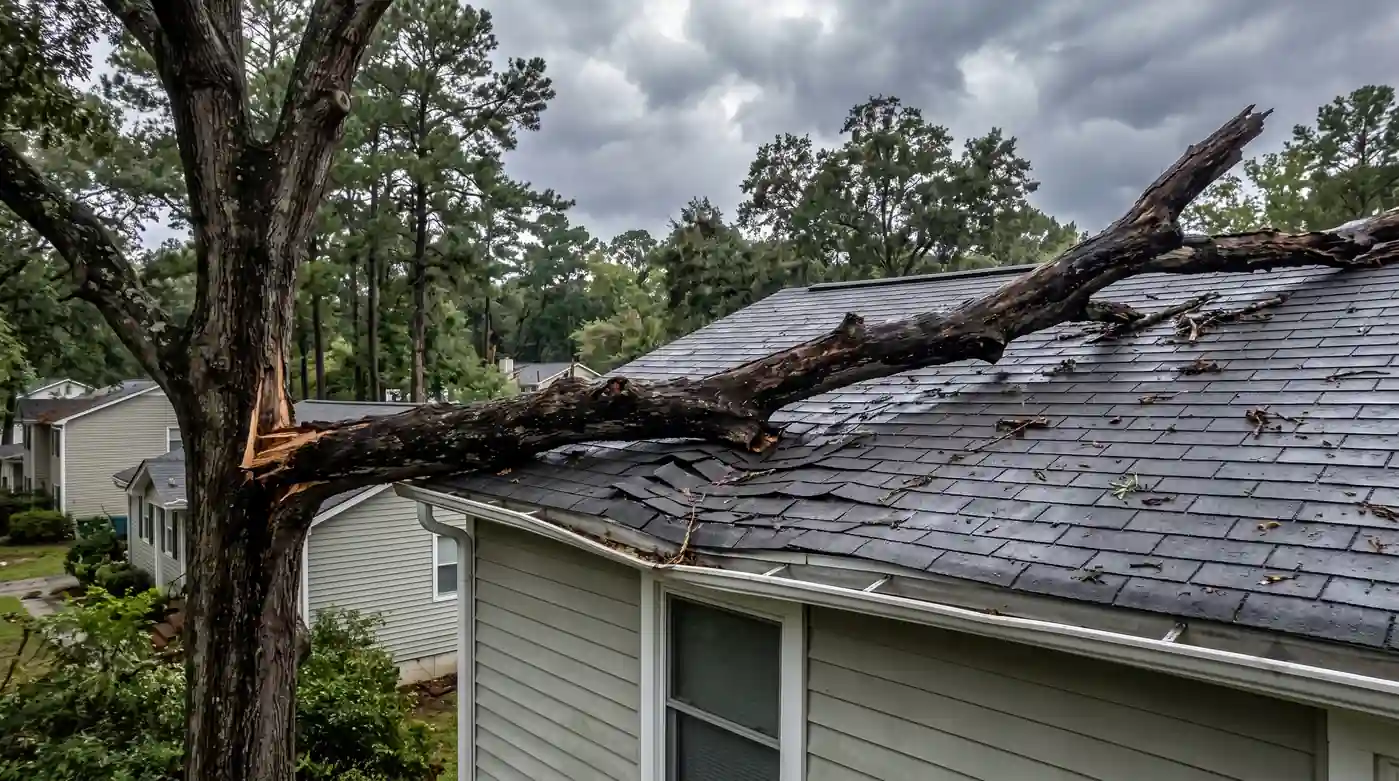
A falling tree or large branch does not discriminate between what it lands on. A mature Water Oak or Loblolly Pine carrying hundreds — sometimes thousands — of pounds of wood can come down with enough force to punch straight through a roof, collapse a wall, destroy a deck, crush a parked vehicle, or take out a fence line in seconds.
The structural damage caused by a direct tree strike on a home can run into tens of thousands of dollars in repairs and, in severe cases, render a home temporarily or permanently uninhabitable.
The damage rarely stops at the tree itself, either. Root failures can heave driveways and crack foundations. Falling branches can shatter windows and damage gutters. And a tree that falls across a property line can destroy a neighbor’s structure just as easily as your own — bringing an entirely separate set of problems with it.
South Carolina’s Weather Makes Every Dangerous Tree More Urgent
If you live anywhere in South Carolina, you already know that the weather here does not go easy on trees. The state sits squarely in the path of Atlantic hurricane season, which runs from June through November and brings not just direct storm threats but weeks of elevated tropical moisture, sustained winds, and rapid weather system development that can catch homeowners off guard.
Hurricane-force winds and tropical storm gusts are among the most powerful forces a tree will ever face. A tree that is already compromised — whether by internal decay, root damage, a structural lean, or previous storm stress — is exponentially more likely to fail under these conditions than a healthy one.
What might have been a survivable wind event for a healthy Southern Live Oak becomes a catastrophic failure event for one that has been weakened and left standing.
Beyond hurricane season, South Carolina’s summer thunderstorm pattern brings powerful, fast-moving storms with high straight-line winds, heavy rainfall, and lightning strikes that can structurally compromise a tree in a matter of minutes.
Winter brings its own threat in the form of ice storms, which are particularly destructive to trees because ice accumulation adds enormous weight to branches and canopies that were never designed to carry it, and the added load causes sudden, unpredictable failures with very little wind required.
Every dangerous tree on your property is one South Carolina storm away from becoming an emergency.
The Financial Consequences Go Beyond Repair Costs
The immediate repair bill after a tree strikes a structure is painful enough. But many South Carolina homeowners don’t realize the broader financial exposure they carry when a known hazardous tree is left standing on their property.
Homeowners’ insurance policies vary widely, and many carriers take a firm position on damage caused by trees that were in a visibly deteriorated or hazardous condition prior to the loss event. If an adjuster or inspector determines that the tree was obviously dead, leaning, or structurally compromised before it fell — and that the homeowner had a reasonable opportunity to address it — the claim can be reduced, disputed, or denied outright.
What should have been a covered loss becomes an out-of-pocket expense, on top of the removal cost you still have to pay anyway.
Beyond your own insurance situation, if a hazardous tree on your property falls and damages a neighboring home, vehicle, or injures a person, you may be exposed to significant personal liability. The legal and financial exposure in these situations can be serious, and the defense of “I didn’t know it was that dangerous” carries very little weight when the warning signs were visible.
Someone Could Be Seriously Hurt
Property damage is costly and stressful. But the risk that weighs heaviest is the risk to people. South Carolina families spend time in their yards every day — children playing, neighbors visiting, guests parking in the driveway. A falling tree or a dropped widow-maker branch does not announce itself, and it does not give anyone time to move.
Serious injuries and fatalities from falling trees and branches happen every year across the country, and the vast majority of them involve trees that showed warning signs well before the failure occurred. No repair bill, no insurance payout, and no amount of regret can undo the consequences of a tree strike that injures someone on your property.
The Longer You Wait, the More Difficult the Removal Becomes
There is also a very practical reason not to delay: the condition of a hazardous tree directly affects how safely and efficiently it can be removed. A tree that is caught early — still structurally sound enough to be felled in a controlled manner — is a straightforward removal.
A tree that has been left to continue deteriorating may reach a point where the wood is so compromised that standard removal methods become significantly more complicated, time-consuming, and expensive.
Severely decayed wood behaves unpredictably under cutting equipment. Root systems that have fully failed make a tree far more unstable during the removal process itself. Trees that have already begun to fall and are hung up on structures or other trees create dangerous and complex rigging situations. In short, the window for a clean, safe, and cost-effective removal narrows the longer a dangerous tree is left standing.
Addressing a hazardous tree early is not just the safer decision — it is almost always the less expensive one as well.
Emergency Removal Costs More Than Planned Removal
This point is worth stating plainly because it surprises many homeowners. Emergency tree removal — the kind that happens at 2 a.m. after a storm drops a tree on your roof, or on a holiday weekend when a tree comes down across your driveway — costs significantly more than a scheduled removal carried out under normal conditions.
Emergency response requires crews and equipment to be mobilized quickly, often outside of regular business hours, and the complexity of the work is almost always higher when a tree has already fallen or partially failed.
The most cost-effective time to remove a dangerous tree is before it becomes an emergency. A free estimate from South Carolina Tree Removal Experts costs you nothing. The alternative can cost you far more than you expect.
Our Tree Removal Services in South Carolina
At South Carolina Tree Removal Experts, we offer a full range of professional tree removal services designed to handle every situation a South Carolina homeowner or property manager is likely to face. Whether you are dealing with a single dead tree in a tight backyard, a massive storm-damaged Southern Live Oak overhanging your roof, or a property full of hazardous trees that need to come down before hurricane season arrives, we have the experience, the equipment, and the trained crew to get the job done safely, efficiently, and with full respect for your property.
Every service we provide is backed by 38 years of hands-on experience in South Carolina, full licensing and insurance coverage, and a genuine commitment to leaving your property cleaner than we found it. Here is a closer look at the tree removal services we offer across the state.
Dead Tree Removal
A dead tree is one of the most urgent removal situations on any residential or commercial property, yet it is also one of the most frequently delayed. Many homeowners assume that a dead tree poses less of a risk than a living one, when in fact the opposite is true. Once a tree dies, its internal wood begins to decay and soften, a process that accelerates significantly in South Carolina’s hot, humid climate. What starts as a structurally compromised tree can become an unpredictable and imminent collapse risk within a single growing season.
Our dead tree removal service covers trees of all sizes and species — from smaller ornamental trees in residential yards to large Loblolly Pines and Water Oaks that have reached the end of their lifespan on larger properties. We assess each tree individually, select the safest and most appropriate removal method based on the tree’s condition, its location, and what surrounds it, and we handle full debris cleanup so your yard is left clear and ready once the work is complete.
If you have a dead tree on your South Carolina property — even one that appears stable right now — do not wait for the next storm to make the decision for you. (Learn more about our Dead Tree Removal service.)
Hazardous Tree Removal
Not every dangerous tree is a dead one. A living tree can pose just as serious a threat to your home, your family, and your neighbors when it has developed structural problems that compromise its ability to stay standing under stress. Significant leans, split or cracked trunks, major root damage, large dead sections within an otherwise living canopy, and trees that have grown too close to structures or power lines all fall into the category of hazardous trees — and all of them require professional attention.
Hazardous tree removal is among the most technically demanding work we do, because the very conditions that make a tree dangerous also make it more unpredictable to remove. Our experienced crew approaches every hazardous removal with a thorough on-site risk assessment, a clear plan for controlling the removal process, and the equipment needed to execute that plan safely — including crane-assisted removal when the situation calls for it.
South Carolina’s hurricane season and severe summer storm pattern mean that hazardous trees are more likely to fail in a shorter time frame than they might in other parts of the country. If a tree on your property has you concerned, the right move is to get it assessed now — before the weather makes the decision for you. (Learn more about our Hazardous Tree Removal service.)
Crane-Assisted Tree Removal
Some trees simply cannot be removed using standard felling methods. When a tree is too large, positioned too close to a home or other structure, located in a space with limited ground access, or so compromised by storm damage that its fall direction cannot be reliably controlled, crane-assisted removal is the safest and most effective solution.
Crane-assisted tree removal is a method in which a rigging crane lifts and extracts sections of a tree vertically, carrying them away from the work zone with precision, eliminating the risk of an uncontrolled fall. This approach protects your home, your landscaping, your vehicles, and any other structures on the property from the damage that could result from a conventional felling operation in a confined space.
At South Carolina Tree Removal Experts, we have been performing crane-assisted removals for decades, and it is one of the services that most clearly separates a truly experienced, fully equipped tree removal company from a general crew with basic equipment. If you have a large tree — a mature Southern Live Oak, a towering Tulip Poplar, or an oversized Loblolly Pine — situated anywhere near your home or outbuildings, crane-assisted removal may be exactly the right approach for your situation. (Learn more about our Crane-Assisted Tree Removal service.)
Tree Cutting and Felling
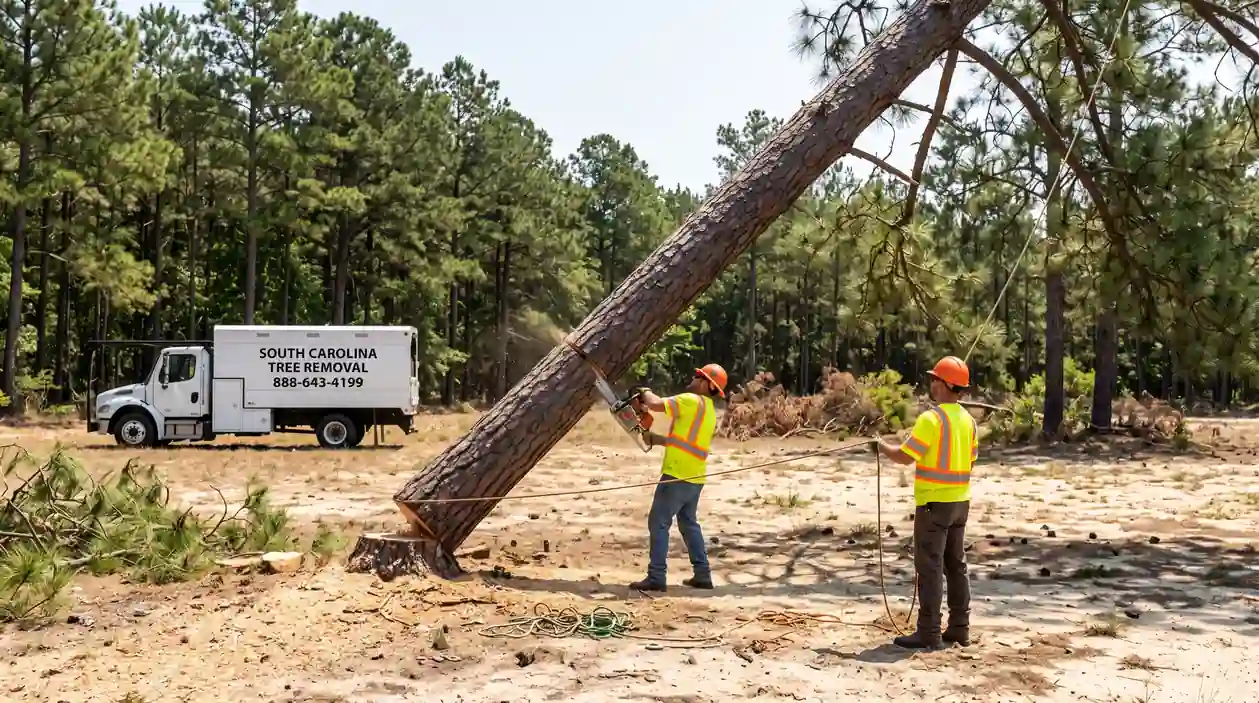
Tree cutting and felling is the foundation of professional tree removal work — the controlled process of cutting a tree at its base and directing it safely to the ground within a predetermined fall zone. While it may sound straightforward, professional tree felling requires a detailed understanding of tree physics, wood behavior under stress, site conditions, and cutting techniques that ensure the tree falls exactly where it is supposed to — and nowhere else.
Our tree cutting and felling service is appropriate for trees that have sufficient open space around them for a controlled ground-level fell, including trees being cleared for land development, trees on larger rural properties, overgrown Sweetgums or Loblolly Pines crowding structures or other trees, and trees with a natural lean that can be used advantageously in the felling direction.
Every felling operation begins with a careful site assessment, a clearly defined fall zone, and a step-by-step safety plan before a single cut is made.
Whether you need a single tree cut down or an entire stand of trees cleared from a lot, our crew brings the experience, equipment, and professional judgment to do it right. (Learn more about our Tree Cutting and Felling service.)
Emergency Tree Removal — Available 24/7
No tree removal service overview for South Carolina would be complete without addressing emergency situations, because the reality of living in this state is that storms happen — and they happen fast. A hurricane, a powerful summer thunderstorm, or an unexpected ice storm can bring a tree down onto your home, your vehicle, or across your driveway in the middle of the night with no warning at all.
South Carolina Tree Removal Experts provides 24/7 emergency tree removal service across the state. When a tree falls on your property, and the situation is urgent, our team mobilizes quickly to assess the situation, make the area safe, and begin the removal process as quickly as possible.
We understand that an emergency tree removal is not just a tree problem — it is a home safety problem, a family stress problem, and often an insurance claim problem all at once. We handle the tree so you can focus on everything else.
For any emergency tree situation in South Carolina, call us immediately at (888) 643-4199. We are available around the clock, every day of the year. (Learn more about our Emergency Tree Removal service.)
How Does Our Tree Removal Process Work?
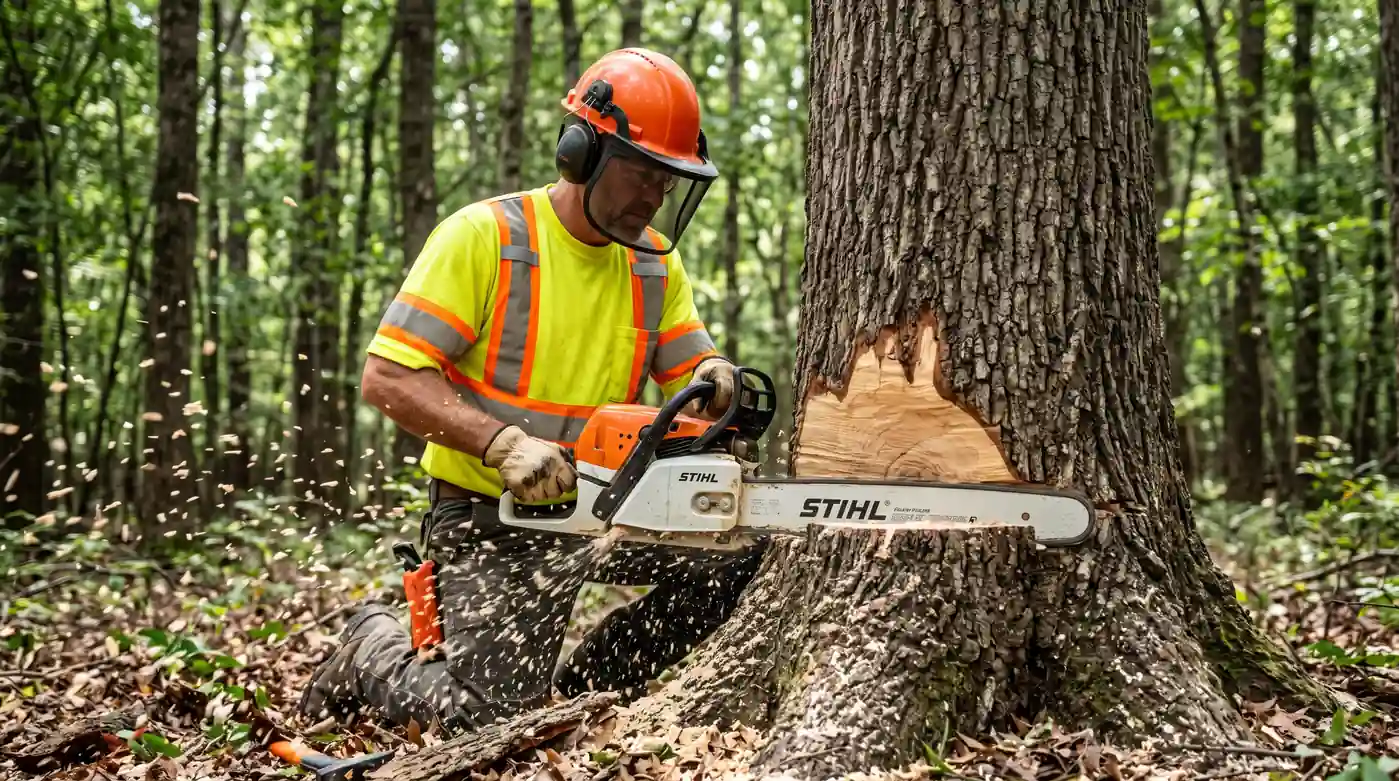
Having a tree removed from your property is a significant job, and we understand that most South Carolina homeowners have never been through the process before. Knowing exactly what to expect from start to finish makes the entire experience less stressful and helps you feel confident that the work is being handled properly.
At South Carolina Tree Removal Experts, we follow a clear, structured process on every single job we take on — whether it is a straightforward dead tree removal in a Lexington backyard or a complex crane-assisted operation near a Charleston home. That process has been refined over 38 years of working on South Carolina properties, and it is designed to prioritize safety, efficiency, and full respect for your property at every step.
Step 1: Free On-Site Estimate
The process begins with a free, no-obligation estimate at your property. One of our experienced team members visits your site, examines the tree or trees in question, evaluates the surrounding area, and provides a clear, honest assessment of what the job entails.
We take the time to answer every question you have about the removal — how it will be approached, what equipment will be used, how long it will take, and what the cleanup process looks like. There are no surprises, no hidden fees, and no pressure — just straightforward, professional guidance from a team that has been doing this work in South Carolina for nearly four decades.
Step 2: Safety Assessment and Job Planning
Before any equipment is unloaded and before any cuts are made, our crew conducts a thorough on-site safety assessment. This means identifying every potential hazard in and around the work zone — overhead power lines, nearby structures, underground utilities, foot traffic patterns, and the specific structural condition of the tree itself.
Based on that assessment, we develop a detailed job plan that outlines the removal method, equipment positioning, the fall or lift zone, and the sequence of cuts or rigging operations. Every member of our crew knows the plan before work begins, and safety remains the governing priority from the first cut to the final cleanup.
Step 3: Professional Tree Removal
With the safety plan in place, our crew executes the removal using the method best suited to your specific situation. For trees with sufficient open space, controlled felling is used to bring the tree down cleanly in a single operation or in large sections.
For trees positioned near structures, vehicles, or in confined spaces, sectional removal or crane-assisted lifting is used to extract the tree piece by piece with precision — eliminating the risk of an uncontrolled fall. According to the USDA Forest Service, proper planning and execution of tree removal operations is essential to protecting people, property, and the surrounding environment — a standard we have upheld on every job for 38 years.
Step 4: Complete Debris Cleanup
Once the tree is down, our job is not finished. Our crew handles all debris removal — cutting larger wood sections into manageable pieces, clearing branches and brush from the work area, and leaving your yard clean and clear.
We do not consider a job complete until your property looks the way it should — free of debris and hazards, and ready for whatever comes next. If you would like the wood left in cut sections for firewood, we are happy to accommodate that request as well.
What Happens After the Tree Is Removed?
Once the tree is removed, our crew reviews the remaining cut area, cleanup needs, and any site conditions that should be addressed before the job is complete. We will also walk you through any follow-up steps relevant to your specific property, whether that involves reviewing the surrounding trees for similar concerns or advising on the cleared area going forward.
Our relationship with South Carolina homeowners does not end when the last branch hits the ground. It ends when you are completely satisfied with the work that was done.
Why South Carolina Homeowners Have Trusted Us for 38 Years
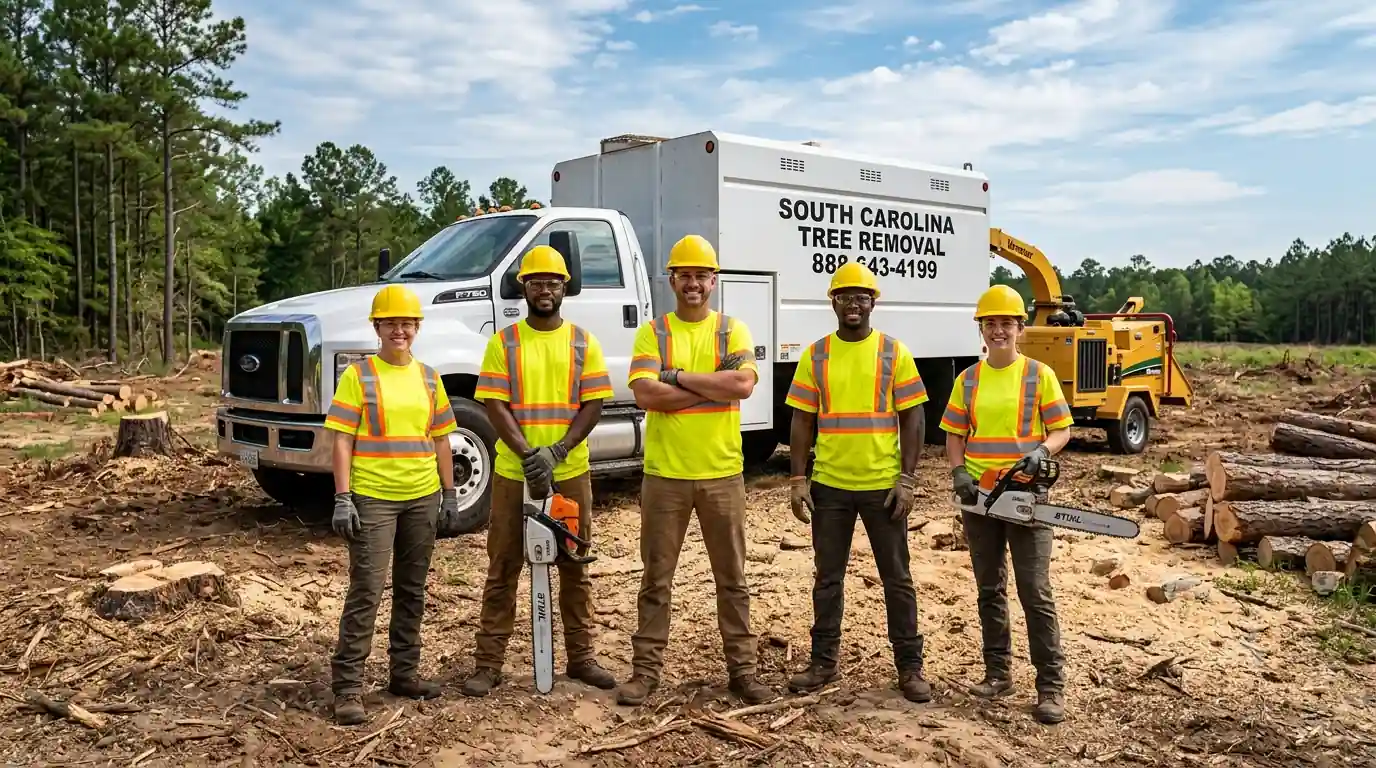
Choosing the right tree removal company is not a decision most South Carolina homeowners take lightly. You are inviting a crew onto your property with heavy equipment, chainsaws, and the task of safely bringing down a structure that could weigh several tons — and the difference between a company that knows exactly what it is doing and one that does not can be the difference between a clean, professional job and a damaged roof, a crushed fence, or an injury on your property.
South Carolina Tree Removal Experts has been earning the trust of homeowners, landlords, and property managers across this state for 38 years. That trust is not built on advertising — it is built on showing up, doing the work right, and standing behind every job we complete.
We Are Fully Licensed and Insured in South Carolina
Every tree removal job carries inherent risk, and the only responsible way to take it on is to be fully covered. South Carolina Tree Removal Experts is fully licensed and insured in South Carolina, meaning every job we perform is backed by proper liability and workers’ compensation coverage.
This matters enormously for you as a homeowner. When an unlicensed or uninsured crew works on your property, and something goes wrong — whether that is property damage or a worker injury — the financial and legal exposure can fall directly on you. Choosing a licensed and insured company like South Carolina Tree Removal Experts is not just a quality decision; it is a protection decision.
38 Years of Hands-On Experience in South Carolina
There is no substitute for experience, and there are very few tree removal companies in South Carolina that can match what we bring to the table. Over 38 years of active operation in this state, our crew has handled thousands of removals across every type of property, every tree species, and every degree of complexity — from routine backyard removals in Columbia and Lexington to large-scale, crane-assisted operations in Charleston and Hilton Head.
That depth of experience means that when our crew arrives at your property, they have almost certainly handled a situation very similar to yours before. They know how Loblolly Pines behave when their root systems are compromised. They know how Southern Live Oaks respond to undercutting equipment. They know how South Carolina’s clay soils affect root stability after heavy rainfall. That kind of local, species-specific, terrain-specific knowledge simply cannot be learned from a training manual — it comes from decades of doing the work on South Carolina soil.
We Offer Free Estimates on Every Job
We believe that every South Carolina homeowner deserves honest, transparent information before committing to any tree removal work. That is why we offer free, no-obligation estimates on every job we take on — no pressure, no sales tactics, and no hidden fees buried in the fine print.
When one of our team members comes to your property for an estimate, you get a real assessment from a real professional. You get a clear picture of what the job involves, the approach we recommend, and the cost of the work — so you can make an informed decision with complete confidence.
24/7 Emergency Tree Removal Availability
South Carolina storms do not keep business hours, and neither do we. Our emergency tree removal service is available 24 hours a day, 7 days a week, 365 days a year — because when a tree comes down on your home at midnight during a hurricane, you need a crew that answers the phone and gets moving immediately.
Fast emergency response is built into the core of how we operate, because after nearly four decades of serving South Carolina homeowners through hurricane seasons, tropical storms, and severe summer weather, we know that tree emergencies are real, urgent, and cannot wait until Monday morning.
An Experienced, Local Crew That Knows South Carolina
Every member of our crew is experienced, trained, and deeply familiar with the tree species, soil conditions, and weather patterns that define South Carolina properties. We are not a national franchise dispatching unfamiliar contractors to your door — we are a local South Carolina tree removal company with deep roots in this state and a genuine stake in the communities we serve.
From the Upstate cities of Greenville and Spartanburg to the Lowcountry communities of Charleston, Summerville, and Hilton Head, and everywhere in between, our team knows this state, knows its trees, and knows how to work safely and efficiently on South Carolina properties of every size and type. When you call South Carolina Tree Removal Experts, you are getting a crew that treats your property with the same care they would give their own.
Safe and Efficient Methods on Every Job
Safety and efficiency are not competing priorities — when a job is planned and executed correctly, you get both. Our crew uses proven, professional removal methods on every job, selected based on the specific conditions of each tree and each property.
For straightforward removals with adequate space, controlled felling gets the job done quickly and cleanly. For complex situations involving proximity to structures, limited access, or trees in compromised condition, we bring in the equipment and techniques — including crane-assisted removal — needed to execute the job safely without cutting corners. No matter the size or complexity of the job, South Carolina Tree Removal Experts approaches every removal with the same standard of care that has kept our reputation intact for nearly four decades.
Proudly Serving All of South Carolina
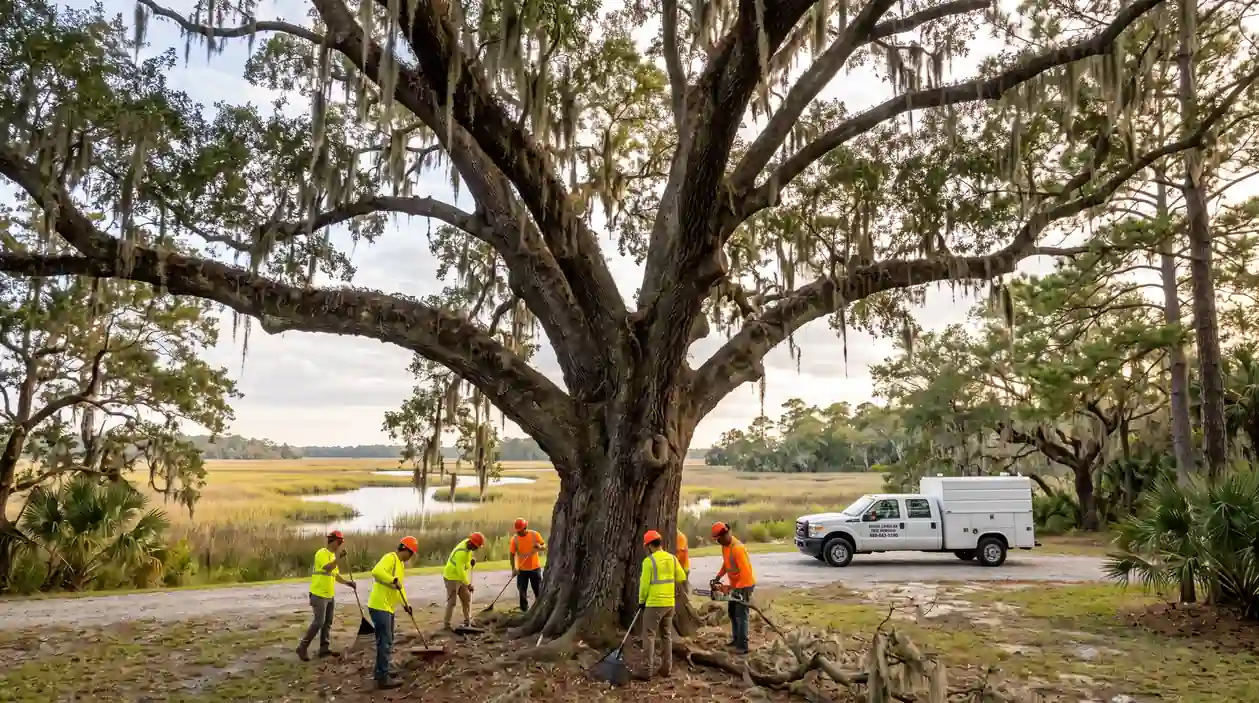
South Carolina is a state of remarkable variety — from the rolling hills and dense hardwood forests of the Upstate to the sprawling coastal plains and centuries-old live oak canopies of the Lowcountry. The challenges homeowners face in Greenville look very different from those in Myrtle Beach, Charleston, or Florence.
That is exactly why local experience matters so much in this business. South Carolina Tree Removal Experts has been working across every region of this state for 38 years, and that statewide experience gives us a depth of understanding that no out-of-state company or recently established crew can replicate.
Serving the Upstate
The Upstate region is home to some of South Carolina’s most densely wooded residential properties, with large stands of Loblolly Pine, Tulip Poplar, and Sweetgum common across yards and lot lines. Greenville, Spartanburg, and Anderson are among the fastest-growing cities in the state, meaning more homeowners are dealing with trees too close to new structures or damaged by powerful Upstate thunderstorms.
Our crew serves Greenville, Spartanburg, Anderson, and the surrounding Upstate communities with the same professionalism and responsiveness we bring to every part of South Carolina. Whether it is a single hazardous tree in a Greenville backyard or a full lot clearing job outside Spartanburg, we are equipped and ready.
Serving the Midlands
Columbia and the broader Midlands region sit at the geographic heart of South Carolina, and the tree removal needs here are as varied as the properties themselves. From established neighborhoods in Forest Acres and Irmo with large aging Water Oaks overhanging older homes, to newer developments in Lexington and Blythewood where lot clearing is an ongoing need, the Midlands keeps our crew busy year-round.
Columbia’s central location means it sits in the path of weather systems from every direction, producing the kind of storm activity that consistently causes tree damage and emergency removal needs. South Carolina Tree Removal Experts has been serving Columbia and the surrounding Midlands communities for decades, and we know this region’s trees and terrain better than anyone in the business.
Serving the Lowcountry
The Lowcountry presents some of the most distinctive and demanding tree-removal challenges in the state. The region’s iconic Southern Live Oaks — many of them decades or even centuries old with massive spreading canopies — require a level of experience and equipment capability that not every tree removal company can offer.
Charleston, Summerville, Goose Creek, and the surrounding communities also sit directly in the path of the Atlantic hurricane season, making storm-related tree emergencies a consistent reality here. Our team has extensive experience managing post-storm removals throughout the Lowcountry, and we are ready to respond fast when severe weather strikes.
Serving the Grand Strand and Coastal Communities
Myrtle Beach and the Grand Strand are home to a mix of year-round residents, vacation property owners, and commercial developments, all sharing a landscape dominated by Loblolly Pines and Sweetgums. The sandy coastal soils along the Grand Strand significantly affect root stability, and trees in these soils can lose their footing much more quickly during storm events than most homeowners expect.
We serve Myrtle Beach, North Myrtle Beach, Conway, Surfside Beach, Murrells Inlet, and the surrounding Grand Strand communities with full tree removal capability, including 24/7 emergency storm response. Vacation property owners and property managers along the coast rely on us year-round to keep their properties safe and their trees under control.
Serving the Pee Dee Region and Beyond
The Pee Dee region — anchored by Florence and extending through Darlington, Hartsville, and Marion — is an area where large properties and heavily wooded lots create a consistent demand for professional tree removal and land-clearing services. Trees in the Pee Dee tend to grow large and fast in the region’s fertile soils, and storms moving through the area can leave significant damage across properties far from the nearest town.
South Carolina Tree Removal Experts serves Florence and the broader Pee Dee region with the same full range of services we offer across the rest of the state. Every South Carolina homeowner deserves the same professional, responsive, and thorough tree removal experience regardless of their zip code.
Every City. Every Region. One Trusted Name.
From Rock Hill and Fort Mill in the north to Hilton Head and Beaufort in the south, from Aiken and North Augusta in the west to Florence and the Pee Dee in the east, South Carolina Tree Removal Experts serves the entire state. Our priority service cities include Columbia, Charleston, Greenville, Myrtle Beach, Spartanburg, Rock Hill, Summerville, Florence, Hilton Head, Anderson, Aiken, and Lexington.
If you are a South Carolina homeowner, property manager, or business owner with a tree removal need — regardless of where in the state you are located — South Carolina Tree Removal Experts is ready to help. We have been the name South Carolina trusts for nearly four decades, and that is a reputation we work hard to earn on every single job.
High-Priority Tree Removal Services Across Midlands & Upstate
If you’re dealing with tree hazards near power lines, rooflines, or parking areas in major South Carolina corridors like Columbia, Rock Hill, or Cayce, our local crews provide scheduled and urgent removals:
- Local Columbia & Richland County Response: Addressing rapid tree decline, soil saturation challenges along river corridors, and overgrown pines near residential structures.
- Rock Hill & York County Precision Felling: Controlled sectional dismantling for suburban subdivisions and tight lot boundaries.
- Complete Cleanup & Timber Haul-Away: We process heavy logs and haul away limbs so your lawn remains pristine and safe.
Commercial Tree Removal & Property Management Services
Managing commercial properties, multi-family housing complexes, industrial parks, or municipal rights-of-way in South Carolina demands a higher tier of safety, coordination, and reliability. Hazardous trees threatening parking areas, tenant structures, or utility corridors are serious financial and safety liabilities.
South Carolina Tree Removal Experts works directly with commercial property managers, general contractors, HOAs, and municipalities across the state:
- Full OSHA Compliance & Zero-Impact Operations: We enforce rigid drop-zone perimeters to protect pedestrian traffic, parked vehicles, and surrounding commercial structures.
- Commercial General Liability & Workers’ Comp: Fully insured in South Carolina with comprehensive commercial coverage and certificates of insurance provided upon request.
- Off-Hours & Emergency Scheduling: We accommodate tenant business hours by offering flexible morning, weekend, or 24/7 emergency response to minimize business interruption.
- Written Commercial Proposals: Clear, itemized scopes of work for board reviews, property audits, and insurance compliance.
Frequently Asked Questions About Tree Removal in South Carolina
How Much Does Tree Removal Cost in South Carolina?
Tree removal costs in South Carolina typically vary based on several factors, including the size of the tree, its location on the property, its condition, and the complexity of the removal method required. A small to medium tree in an open yard with easy access will cost considerably less than a large, storm-damaged Southern Live Oak positioned close to a structure requiring crane-assisted removal.
Additional cost factors include how much debris needs to be hauled away, how difficult the site is to access, and whether the job requires emergency response outside of regular business hours. The best way to get an accurate number for your specific situation is to call South Carolina Tree Removal Experts at (888) 643-4199 for a free, no-obligation on-site estimate.
How Long Does Tree Removal Take?
Most standard residential tree removals in South Carolina are completed within a single day, and many smaller jobs are finished in just a few hours. Larger, more complex removals — particularly those involving crane-assisted operations or multiple trees on the same property — may take longer depending on the scope of the work.
During your free estimate, our team will give you a clear timeframe for your specific job so you know exactly what to expect before work begins. We work efficiently and without unnecessary delays, because we respect your time as much as we respect your property.
Do I Need a Permit to Remove a Tree in South Carolina?
Permit requirements for tree removal in South Carolina vary by city or county where your property is located, and in some cases by the species and size of the tree in question. Some municipalities — particularly in the Charleston and Columbia areas — have specific tree ordinances that regulate the removal of certain protected or heritage tree species.
We strongly recommend checking with your local city or county planning office before removing any tree that may be protected under local ordinances. Our team is familiar with tree removal regulations across South Carolina and can help point you in the right direction during your estimate.
Is Tree Removal Covered by Homeowners Insurance in South Carolina?
Whether your homeowners’ insurance covers tree removal depends largely on the circumstances of the removal and the specific terms of your policy. In many cases, insurance will cover the cost of removing a tree that has fallen on a covered structure — such as your home, garage, or fence — as a result of a storm or other covered weather event.
However, the removal of a standing dead or hazardous tree that has not yet caused damage is typically not covered by standard homeowners’ insurance policies, as it is generally considered a maintenance responsibility. We recommend reviewing your policy carefully and speaking with your insurance provider directly to understand your specific coverage before scheduling a removal.
Is It Safe to Remove a Tree Myself in South Carolina?
Tree removal is one of the most dangerous home improvement tasks a property owner can attempt without professional training and proper equipment. Chainsaw injuries, unpredictable fall directions, contact with power lines, and the structural unpredictability of damaged or decayed trees create a combination of hazards that injure and kill untrained individuals every year across the country.
Beyond the personal safety risk, an improperly executed DIY tree removal can cause serious damage to your home, your neighbor’s property, underground utilities, and your own landscaping — damage that may not be covered by your homeowners’ insurance if it results from an owner-performed removal. For any tree removal on your South Carolina property, the safest and smartest decision is always to call a licensed, insured, and experienced professional.
Get Your Free Tree Removal Estimate Today
When there is a dangerous, dead, or unwanted tree on your South Carolina property, every day you wait is another day of unnecessary risk. Storms do not give advance notice, trees do not get more stable with time, and the cost of inaction almost always exceeds the cost of a professional removal done right.
South Carolina Tree Removal Experts is ready to help you right now. For 38 years, we have been the tree removal company that South Carolina homeowners, property managers, and businesses turn to when the job matters and the stakes are high. We are licensed and insured, we offer free estimates on every job, and we are available 24 hours a day, 7 days a week for emergency situations that simply cannot wait.
One call is all it takes to get a clear, honest, no-obligation estimate from one of the most experienced tree removal crews in South Carolina. Whether you are dealing with a single dead Loblolly Pine in your backyard, a massive Southern Live Oak threatening your roof, or a storm emergency in the middle of the night — we have the experience, the equipment, and the commitment to get it done safely and efficiently.
Do not wait for the next storm to make the decision for you. Call South Carolina Tree Removal Experts today and let us take the risk off your property and off your plate.
Call (888) 643-4199 now for your free tree removal estimate — serving all of South Carolina, 24/7.
Need Tree Removal Fast?
Our local crews are currently serving Hollywood.
Frequently Asked Questions in Hollywood
How long does Tree Removal take in Hollywood?
Usually completed in one day for standard properties in Hollywood.
Do I need a permit in Hollywood?
We help navigate South Carolina and Hollywood municipal tree removal permit requirements.
Area Service Info
Nearby Communities We Also Serve
Local tree removal and land clearing support for Charleston County and surrounding areas.
Ready to Secure Your Hollywood Property?
Our experienced crews provide safe removal planning and careful execution for Hollywood property owners. Schedule your free evaluation today.